Hey guys.
The best kiteboard for beginners is not the one that looks the fastest. It’s not the pro model your instructor rides. It’s not the carbon race board on sale at the end of the season.
It’s the board that gets you up and riding in the shortest time, survives the crashes that are coming, and doesn’t cost you a fortune to replace when you outgrow it in a year. Buying the wrong kiteboard as a beginner sets you back months. Buying the right one and you’re riding upwind before most people figure out their water start.
Here’s exactly what to look for.
Note: This post contains affiliate links. Full Disclosure.
Twintip or Directional — The First Decision
Before anything else — board type. The best kiteboard for beginners is almost always a twintip. Here’s why.
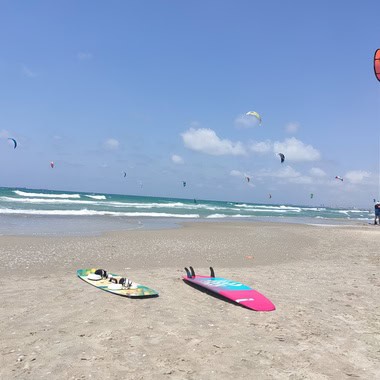
Twintip kiteboards are symmetrical — both ends are identical, both feet point across the board. You ride the same board in both directions without switching your stance. Falls are simple, water starts are learnable in a few sessions, and the learning curve is as short as kiteboarding gets. Every best kiteboard for beginners list starts here.
Directional kiteboards — surfboard-style, one nose and one tail, designed for wave riding. You need to switch your feet when you change direction. Beautiful boards to ride once you can ride. Not the best beginner kiteboard for someone still working on water starts and upwind riding.
Foilboards — designed for hydrofoil riding, where the board lifts completely out of the water on a wing. Not a beginner board by any measure. Come back to this in a year or two.
Twintip. That’s your starting point. Everything else follows from there.
What Size is the Best Kiteboard for Beginners?
Kiteboard size is measured in centimetres — length by width. The best kiteboard for beginners in terms of size is almost always bigger than what experienced riders use. More surface area means more floatation, easier water starts, and more forgiveness when your technique isn’t perfect yet.
Size guide by rider weight:
- Under 60kg — 130–135cm is the best beginner kiteboard size. Enough floatation without being unwieldy.
- 60–75kg — 134–138cm. The sweet spot for most beginner riders. Stable, easy to water start, forgiving in choppy conditions.
- 75–90kg — 138–142cm. More volume to support the weight. Don’t go smaller — you’ll work twice as hard for water starts.
- 90kg+ — 142cm and above. Volume is your friend. A board that’s too small for your weight will exhaust you before you’ve learned anything.
Width matters too. Wider boards have more floatation and are easier to water start — exactly what the best beginner kiteboard needs. Most beginner-oriented boards in the right size range have this built in. Check that the width is 42cm or above for average weight riders.
The common mistake: buying a board the same size your instructor rides. Instructors are experienced — they ride smaller boards because they don’t need the floatation. The best kiteboard for beginners is bigger than you think you need.
What Makes a Good Beginner Kiteboard?
Size is one variable. Construction and design determine whether a board is genuinely the best kiteboard for beginners or just marketed as one.
Flex pattern. The best beginner kiteboard has a soft to medium flex — it absorbs chop and forgives mistakes in technique. Stiff boards transfer every bump directly to your legs and punish imperfect edging. You want soft. As your technique improves you’ll want more response — but not yet.
Rocker. Rocker is the curve of the board from tip to tip. More rocker means the board sits higher in the water, easier to water start, more forgiving in chop. The best kiteboard for beginners has a continuous or moderate rocker — not a flat racing profile.
Fins. Bigger fins = more directional stability = easier to ride upwind = better for beginners. Most beginner kiteboards come with larger fins for exactly this reason. Don’t swap them out for smaller ones until you actually know what you’re doing.
Footpad and strap system. The best beginner kiteboard has a comfortable, adjustable strap system. You’ll be adjusting stance width constantly during your first season as you figure out what works. Pads that are wide and well-cushioned matter more than they look like they do — you’ll be spending a lot of time in those straps.
Durability. Beginners crash. A lot. Into water, into sand, occasionally into things that aren’t water or sand. The best kiteboard for beginners is built to take it. Cheap boards with thin fibreglass shells delaminate fast under beginner use — the board repair guide exists for a reason, but you don’t want to be reading it after your third session.
New or Second-Hand — What’s the Best Kiteboard for Beginners?
Same question as the kite, same honest answer. For most beginners, second-hand is the smarter move.
The case for second-hand:
The best kiteboard for beginners is one that takes punishment without you wincing. A brand new €600 board through a first season of crashes and drags across sandy beaches is painful. A solid second-hand board at half the price takes the same abuse without the same financial sting.
Most riders change board size or style after their first season. Buying second-hand keeps the upgrade cost manageable.
What to check on a second-hand kiteboard:
- Run your hands along the rails — soft spots, delamination, or flex where there shouldn’t be flex
- Check the fin boxes — any cracks, movement, or lifted edges around the box
- Check the inserts for the strap screws — stripped or cracked inserts are a pain to fix
- Check the base for deep gouges or pressure dings that go through the fibreglass
- Press on the deck in a grid pattern — soft spots indicate water ingress or delamination
Minor cosmetic damage is fine. Structural damage — delamination, cracked fin boxes, damaged inserts — is a repair job you’re inheriting. The kiteboard repair guide covers what’s fixable and what isn’t.
If you’re buying a full second-hand setup, the kitesurfing second hand gear guide covers everything — kite, bar, harness, and board in one place.
The case for new:
Warranty, known construction quality, current design improvements, and the confidence that nothing is water-logged or structurally compromised. If budget isn’t the issue — a new board from a reputable brand is the best beginner kiteboard experience. Modern beginner boards are significantly better designed than what was available even three years ago.
What to Look For in the Best Kiteboard for Beginners
Brands and models shift every season. These criteria don’t.
Easy water start. The best kiteboard for beginners gets you out of the water. Period. If a board is hard to water start — it is not the best beginner kiteboard, regardless of what the marketing says. Ask riders who’ve actually learned on it.
Upwind performance. A board that won’t go upwind means you walk back down the beach after every run. The best kiteboard for beginners tracks upwind reliably with a reasonable edge. Bigger fins and a wider outline help here.
Forgiving flex. Chop, bad edging, off-balance landings — a soft flex board absorbs all of it. A stiff board sends all of it straight to your knees. You want soft during your learning season.
Repairability. You will damage your first board. The best beginner kiteboard is made of materials that are fixable with standard epoxy — standard fibreglass construction. Exotic materials like carbon look great and are harder to repair when you need to. Keep it simple.
Brand support. Replacement pads, straps, fin screws — these things get lost and worn. Buy from a brand where spare parts are actually available. F-One, Duotone, North, Slingshot, and Liquid Force all have solid support networks.
What’s NOT the Best Kiteboard for Beginners
A pro or performance model. Stiff, responsive, unforgiving — built for riders who have technique. You don’t yet. Save the pro board for when you actually need it.
A small board. 125cm looks cool. On a beginner it means exhausting, failed water starts and slow progress. Size up. Always.
A directional or wave board. You need to learn basic riding first. Directionals add footswitch complexity you don’t need yet.
A foilboard. Not yet. Not even close.
The cheapest board you can find. No-name boards often have poor insert quality, thin shells that delaminate fast, and fin boxes that fail under normal riding load. You get what you pay for with board construction. The beach safety guide covers gear integrity — a board that fails on the water is a safety issue, not just an inconvenience.
The Decision — Simplified
Step 1 — Twintip only. Not directional, not foil. You’re a beginner.
Step 2 — Size up. Match to your weight using the guide above. When in doubt — go bigger.
Step 3 — Soft to medium flex. Not a race or performance board.
Step 4 — New or second-hand. Budget-conscious — good second-hand is the best kiteboard for beginners move. Want warranty and known construction — buy new.
Step 5 — Check the kite too. Your board and kite need to work together. The kite buying guide covers kite size relative to your weight and wind conditions — the same logic applies to your board choice.
Understanding the wind window helps you understand how your board and kite work together — the board’s job changes completely depending on where in the window the kite is flying.
Quick FAQ
What size kiteboard should a beginner buy?
For most beginners at 70–80kg — a 136–140cm twintip with 42cm+ width. Lighter riders go smaller, heavier riders go bigger. The most common beginner kiteboard mistake is buying too small.
Is a second-hand kiteboard safe to learn on?
Yes, if you inspect it properly. Check for delamination, fin box integrity, insert condition, and deck compression. A well-maintained board from a reputable brand is perfectly solid as the best beginner kiteboard at half the new price.
What brands make the best beginner kiteboards?
Cabrinha, Duotone, North, Slingshot, and Liquid Force all make strong beginner-oriented twintips. The brand matters less than the size and flex — soft flex, right size for your weight, quality fin boxes and inserts.
Do I need lessons before buying a kiteboard?
Yes. Same answer as the kite — lessons first. Your instructor will tell you exactly what size suits your weight and riding style. The complete beginner guide covers why lessons come before gear every time.
How long will a beginner kiteboard last?
A quality board maintained properly lasts years. Check it regularly for pressure dings and fin box movement — the maintenance calendar covers board checks alongside everything else. Minor damage repaired early stays minor. Ignored, it becomes a structural problem.
Can I use any kiteboard to learn on?
Technically yes. Practically — a stiff, small performance board makes learning significantly harder. The best kiteboard for beginners is specifically designed to make water starts, upwind riding, and crash recovery easier. Use one.
First board I bought was second-hand. 138cm, one season old, couple of small rail dings, half the price of new. By the time I actually knew what I wanted from a board I’d ridden it hard for a full season and had saved enough to buy the right one.
Most beginners don’t know what they want from a board until they’ve ridden one for a while. Second-hand twintip in the right size, inspected properly, ridden hard — that’s the best kiteboard for beginners move for most people.
Once you’ve got it — check the maintenance calendar and keep an eye on the fin boxes and rails from day one. Small problems stay small when you catch them early.
Ride hard. 🤙
Got a best kiteboard for beginners recommendation that’s not on the list? Drop it in the comments.




I’ve been riding since 2009 — mostly Red Sea and Mediterranean, a season in Tarifa, a few trips to Brazil. I started this site because the maintenance advice online was either vague or wrong, and I got tired of watching riders show up with gear that should have been retired two seasons ago. I fix what other people ignore.