Hey guys.
Stop guessing your kite size. It’s one of the most common and most expensive mistakes beginners make — buying the wrong size because someone at the beach said so, or because a forum post from 2019 said a 12m is “standard.” Kite size depends on your weight and your wind. Nothing else.
I’ve put together a free kite size calculator you can download, print, and keep in your bag. Weight across one axis, wind speed across the other, right kite size where they meet. Simple, accurate, and based on 20 years of riding and fixing other people’s gear.
Note: This post contains affiliate links. Full Disclosure.
Download the Free Kite Size Calculator
Free. No catch. Print it out and stick it in your kite bag.
How the Kite Size Calculator Works
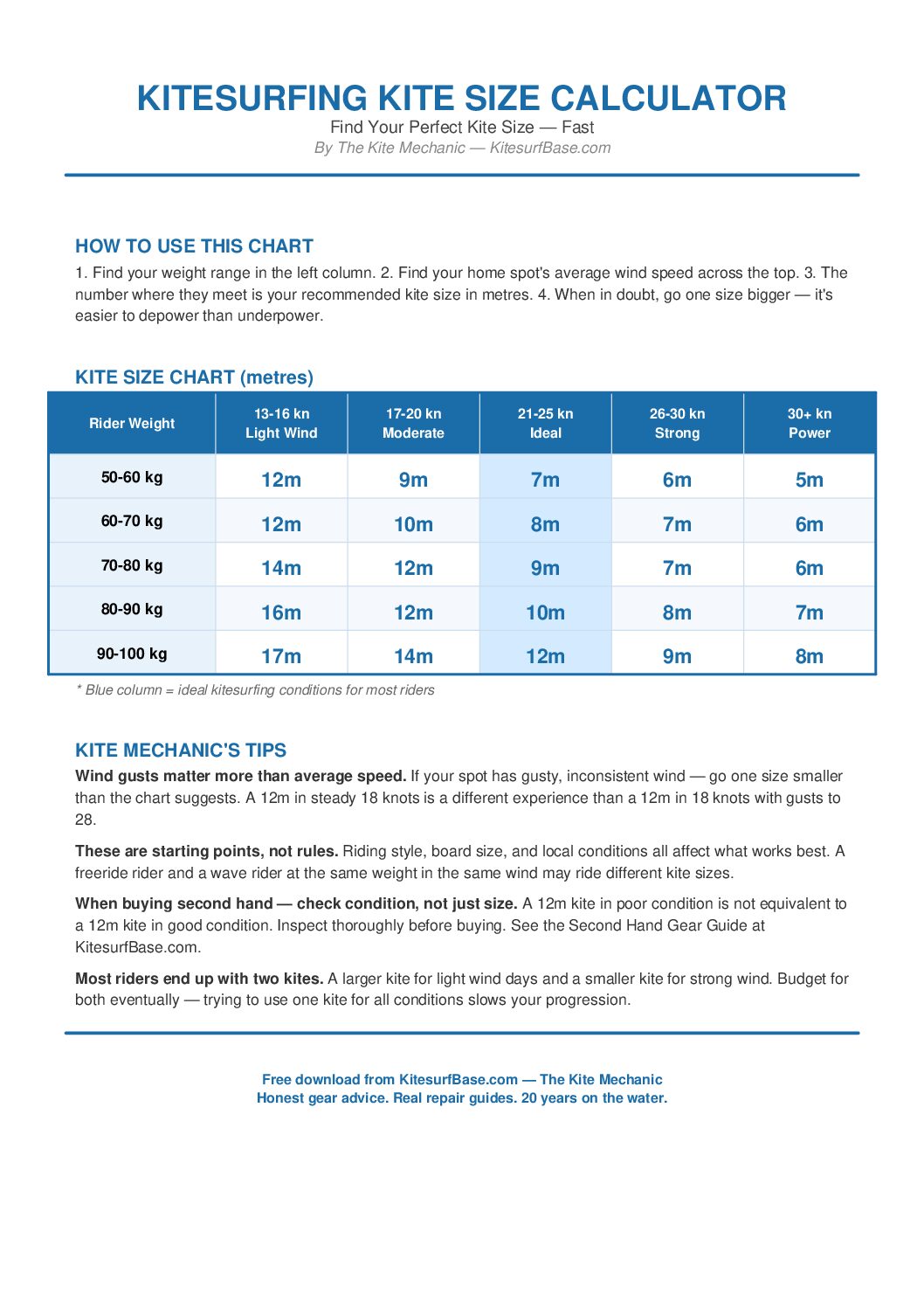
The chart is built around two variables — your weight in kilograms and the average wind speed at your home spot in knots. Find your weight range on the left, find your wind range across the top, and the number where they meet is your recommended kite size.
Here’s the chart in full:
| Rider Weight | 13-16 kn | 17-20 kn | 21-25 kn | 26-30 kn | 30+ kn |
|---|---|---|---|---|---|
| 50-60 kg | 12m | 9m | 7m | 6m | 5m |
| 60-70 kg | 12m | 10m | 8m | 7m | 6m |
| 70-80 kg | 14m | 12m | 9m | 7m | 6m |
| 80-90 kg | 16m | 12m | 10m | 8m | 7m |
| 90-100 kg | 17m | 14m | 12m | 9m | 8m |
The 21 to 25 knot column is highlighted in the PDF — that’s the ideal kitesurfing wind range for most riders and the conditions your primary kite should be sized for.
What Most Riders Get Wrong About Kite Size
They size for the wrong wind. Most beginners buy a kite based on “average” conditions without thinking about what average actually means at their spot. If your home spot runs 15 to 25 knots and you want one kite that covers most sessions — you’re looking at the 17 to 20 knot column as your reference, not the strongest or lightest wind you’ll ever see there.
They listen to other riders without knowing their weight. “Get a 12m” is meaningless advice without knowing who’s giving it and what they weigh. A 12m that’s perfect for an 80kg rider in 18 knots is oversized for a 60kg rider in the same wind and undersized for a 95kg rider. The kite size calculator removes the guesswork. The IKO recommends always matching kite size to rider weight and local conditions — not copying what other riders on the beach are using.
They don’t account for gusts. The chart is based on average wind speed. If your spot is gusty — wide gap between average and peak gusts — go one size smaller than the chart suggests. A 12m in steady 18 knots is a very different experience to a 12m in 18 knots average with gusts to 28. Use a wind forecast app to understand your spot’s gust pattern before buying.
They buy for where they want to be, not where they are. Beginners sometimes size down because advanced riders around them are on smaller kites. Those riders weigh less, have better technique, or are riding in more wind than you are. Buy for your weight and your conditions — not someone else’s.
The Case for Two Kites
Most riders end up with two kites eventually — a larger one for lighter wind days and a smaller one for stronger wind. If you’re budgeting for one kite to start, choose the size that covers the most common conditions at your spot.
If your spot runs 15 to 20 knots most of the time and you weigh 75kg — a 12m is your kite. Save the second purchase for when you know your riding well enough to know what you actually need in different conditions.
The best kite for beginners guide covers what else to look for beyond size — shape, brand, new vs second hand. Find new and second hand Kites at KiteOutlet.
For strong wind days — when the chart is pointing you toward a 9m or smaller — a well-made dedicated small kite is worth having.
Kite Size for Second Hand Gear
Getting kite size right matters even more when buying second hand. A kite that’s the wrong size is a kite you’ll either outgrow immediately or never use in your normal conditions.
Before you buy any second hand kite — check the size against this calculator for your weight and your home spot wind. If it doesn’t match, it’s not the right kite regardless of how good the deal looks. The second hand gear guide covers every other check to make before you hand over money. Find Kites at KiteOutlet.
What the Kite Size Calculator Doesn’t Cover
The chart gives you a solid starting point. A few things it doesn’t account for:
Riding style. Wave riders and freeride riders at the same weight often ride different sizes. Wave riders tend to go smaller for more manoeuvrability. Freeride riders prioritise range and comfort.
Board size. A larger board generates more lift and lets you ride a smaller kite in the same conditions. If you’re on a big beginner board, you may find you can manage slightly less kite than the chart suggests.
Kite design. A high-aspect race kite generates more power per square metre than a delta beginner kite. Two different 12m kites can feel very different in the same wind. The chart assumes a standard recreational kite.
Local conditions beyond average wind. Thermals, offshore effects, sea breezes — some spots have patterns that make the average wind reading misleading. Understanding your local weather is the next step after getting your size right.
FAQs
What size kite do I need for my weight?
It depends on your weight and the wind speed at your spot — both together, not one alone. Use the free kite size calculator above: find your weight range and your average wind speed, and the chart gives you the recommended kite size. For a 70-80kg rider in 17-20 knots, that’s a 12m. In 21-25 knots, a 9m.
Is a 12m kite good for beginners?
For most average-weight beginners (65-80kg) in moderate wind (17-20 knots), yes — a 12m is a solid starting point. It’s forgiving, has a wide wind range, and is the most common beginner kite size. Check the calculator for your specific weight and home spot wind before buying.
What happens if my kite is too big for the wind?
An oversized kite generates too much power for the conditions, making it harder to control and more likely to overpower you in gusts. It also flies poorly in light wind — too much drag, not enough speed to stay aloft cleanly. Size down in strong wind, not up.
What happens if my kite is too small for the wind?
An undersized kite in light wind won’t generate enough power to get you riding. In stronger wind it becomes hard to depower fully, which limits your safety margin. Size up in light wind, not down.
Can I use one kite for all conditions?
You can try — but you’ll have sessions where the kite is too big or too small for the conditions. Most riders eventually own two kites: one for light to moderate wind, one for strong wind. For a single kite, choose the size that covers your most common conditions at your home spot.
How do I know the average wind speed at my spot?
Use a wind forecast app — WindGuru or Windfinder — over several sessions to build a picture of what your spot typically runs. The wind forecast app guide covers how to read the data accurately.
Ride hard. 🤙




I’ve been riding since 2009 — mostly Red Sea and Mediterranean, a season in Tarifa, a few trips to Brazil. I started this site because the maintenance advice online was either vague or wrong, and I got tired of watching riders show up with gear that should have been retired two seasons ago. I fix what other people ignore.