Hey guys.
I’ve driven two hours to a spot based on a forecast and stood on the beach watching a lake.
I’ve also ignored a mediocre forecast, driven thirty minutes, and had one of the best sessions of the year.
Kitesurfing weather is not just a number on an app. It’s wind direction, gust patterns, thermal cycles, local geography, and the gap between what the model predicts and what actually arrives at the beach. Learning to read all of it properly is what separates riders who score sessions from riders who score parking tickets.
This guide covers everything — the apps, the numbers, the wind scale, what to look for, and when to stay home.
This post is part of the complete kitesurfing weather guide.
Note: This post contains affiliate links. Full Disclosure.
The Two Numbers Every Kitesurfing Weather Forecast Shows
Every kitesurfing wind forecast gives you two numbers. Most riders only read one of them.
Average wind speed — the mean wind speed over a given period. This is the headline number. 18 knots. 22 knots. The one that gets you excited or puts you back on the sofa.
Gust speed — the peak wind speed within that same period. This is the number that actually determines whether you can ride safely.
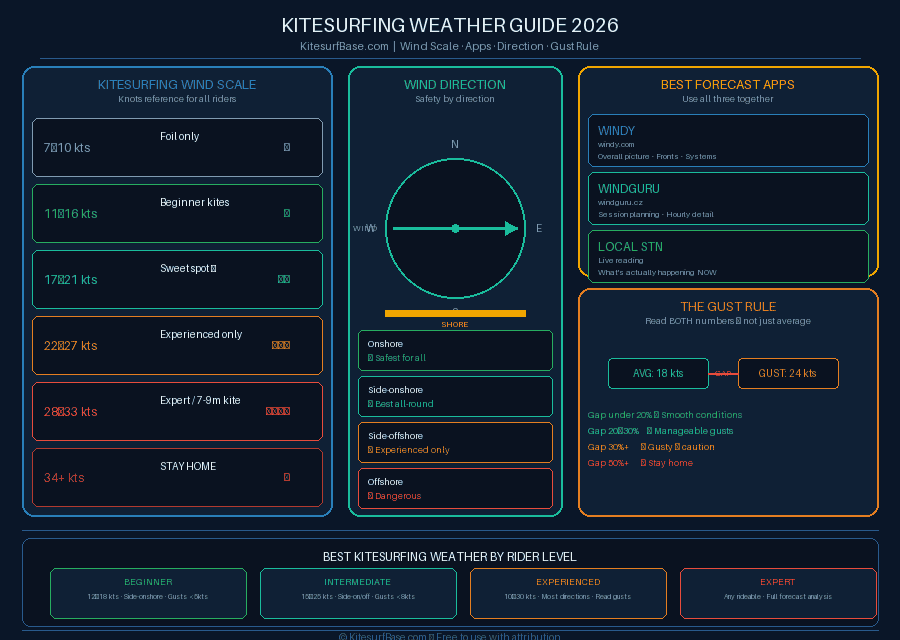
The gap between average and gust is what matters. A forecast of 18 knots average with 24 knot gusts is very different from 18 knots average with 18 knot gusts. The first session is manageable. The second is smooth. Both say “18 knots” if you only read the headline.
Rule of thumb: if the gust speed is more than 30% above the average — conditions are gusty. Gusty kitesurfing weather is harder to ride in, harder to launch in, and harder to self rescue in. Factor that into your decision. The beach safety guide covers how gusty conditions change your launch approach.
The Kitesurfing Wind Scale — What the Numbers Actually Mean
Wind speed numbers mean different things to different riders on different kites. Here’s a straightforward knots-based reference for kitesurfing wind conditions that works regardless of what app you’re using.
7–10 knots — Too light for most setups Small wavelets on the water. Foilers can ride in this, twintip riders generally can’t unless on a very large kite (17m+). Not typical kitesurfing weather for most setups.
11–16 knots — Light to moderate The lower end of kitesurfing conditions for most riders. Beginners on large kites (14–17m), experienced riders on bigger kites. The best weather for kitesurfing beginners starts here — consistent, manageable, forgiving.
17–21 knots — The sweet spot The sweet spot for most kitesurfing. A 12m kite for average weight riders. Consistent power, manageable gusts if the forecast is clean. Most riders’ favourite kitesurfing weather — enough power to ride well without fighting the kite.
22–27 knots — Strong Still very rideable for experienced riders on smaller kites (9–12m). Beginners should sit this out. Gusty 22–27 is a different beast from steady 22–27 — read the gust numbers carefully before committing.
28–33 knots — Expert territory Sea heaps up. Small kites (7–9m). Offshore or side-offshore kitesurfing weather at this level requires a solid self rescue and a good reason to go out. Not a day for experimenting.
34 knots and above — Stay home Seriously.
Wind Direction — More Important Than Wind Speed
Experienced riders check wind direction before wind speed. Kitesurfing weather with the wrong direction is worse than no wind at all.
Onshore (sea to land) — the safest kitesurfing wind conditions for most riders. Any problem and you drift back to the beach. Turbulent close to shore due to land interference — expect choppy, inconsistent wind near the water’s edge.
Side-onshore — the best kitesurfing weather direction for most spots. Clean, consistent wind. If something goes wrong you can still reach the shore. The standard recommendation for beginners.
Side-offshore — good riding conditions for experienced riders who know the spot. The wind is usually cleaner and more consistent coming off the land. If something goes wrong you drift away from shore — you need a practiced self rescue before going out in side-offshore kitesurfing weather. No exceptions.
Offshore (land to sea) — dangerous for almost all riders. Turbulent and gusty near the shore as wind separates from the land. Any gear failure or mistake takes you further from help. Not kitesurfing weather unless you have a support boat and serious experience.
Understanding where your kite sits in the wind window relative to the wind direction is what allows you to manage power and stay safe in any conditions.
The Best Apps for Kitesurfing Weather
Kitesurfing wind forecast apps are not all equal. Here’s what actually works.
Windy — windy.com
The best all-round kitesurfing weather visualisation tool available. Shows wind as animated layers over a map — you can see exactly where the wind is, how it’s moving, and how it changes over the next 10 days. Multiple forecast models available (ECMWF, GFS, ICON) so you can compare predictions.
What to use it for: overall picture, wind direction visualisation, identifying fronts and pressure systems moving through.
What it won’t tell you: hyper-local conditions at your specific beach. The grid resolution isn’t fine enough for that.
Windguru — windguru.cz
The kitesurfing and windsurfing community standard for a reason. Spot-specific forecasts with hourly wind speed, gust, direction, and wave data laid out in a clean table. you can see exactly when 17–21 knots is forecast to arrive and when the gusts drop off.
What to use it for: specific session planning, checking gust vs average spread, timing your session window.
What to watch: Windguru is a model — it’s a prediction, not a guarantee. Check it against a second source.
Local Weather Stations
No app beats a real anemometer reading from a weather station at or near your spot. Many kite beaches have wind stations with live readings. Find yours. A live reading from 2km away is more reliable than any model forecast for what’s happening right now.
The process that actually works:
Check Windy 3-4 days out for the general picture. Check Windguru 24-48 hours out for session timing. Check the live station reading on the morning of the session. If all three agree — go. If they disagree — check again closer to your planned launch time.
Thermals — The Forecast That Changes During the Day
Kitesurfing weather is not static. At many inland and coastal spots, thermals significantly change wind strength throughout the day — often making the forecast look wrong when it’s actually just being modified by local heating.
Thermals develop as the sun heats the land. Warm air rises, pulling in cooler air from the sea. This creates an onshore thermal breeze that often kicks in mid-morning and peaks in the early afternoon before dying off as temperatures equalise in the evening.
At thermal spots:
- Morning sessions often start light and build through the day
- Early afternoon is typically the strongest kitesurfing wind conditions
- Late afternoon can drop off faster than the forecast suggests
- Evening sessions can be glassy and underpowered even after a strong day
If you’re riding a thermal spot for the first time — ask local riders about the pattern. Every spot has its own rhythm and local knowledge beats any model for understanding it.
Reading the Forecast — A Practical Example
Here’s how to read kitesurfing weather for a session decision.
You open Windguru. It shows:
- 10am: 14 knots / gusts 18 knots / side-onshore
- 12pm: 19 knots / gusts 23 knots / side-onshore
- 2pm: 22 knots / gusts 28 knots / side-onshore
- 4pm: 18 knots / gusts 22 knots / side-onshore
What this tells you:
Morning is light — borderline for a 14m kite. Not a great start. Midday builds into solid solid 17–21 knot territory — good riding, manageable gusts. Early afternoon pushes into 22–27 knots with gusts touching 28–33. Strong, gusty, manageable on a smaller kite for experienced riders. Late afternoon settles back into solid conditions.
The session decision:
Arrive at 11:30. Rig a 12m. Ride through the build and peak. Come in before 4pm when the wind might shift as thermals die. Don’t forget to check the maintenance calendar — a pre-session gear check matters more in stronger conditions, not less.
What the Forecast Won’t Tell You
Kitesurfing weather forecasts are models. Models are approximations. There are things no app can tell you.
Local wind shadows. A headland, a building, a tree line — all of these create turbulence and wind shadows that don’t show up in any forecast model. Only local knowledge or observation reveals them.
Sea state lag. Wind builds waves over time. A 20-knot forecast that just arrived won’t have the same sea state as a 20-knot forecast that’s been running for 12 hours. The forecast shows current wind — not current waves.
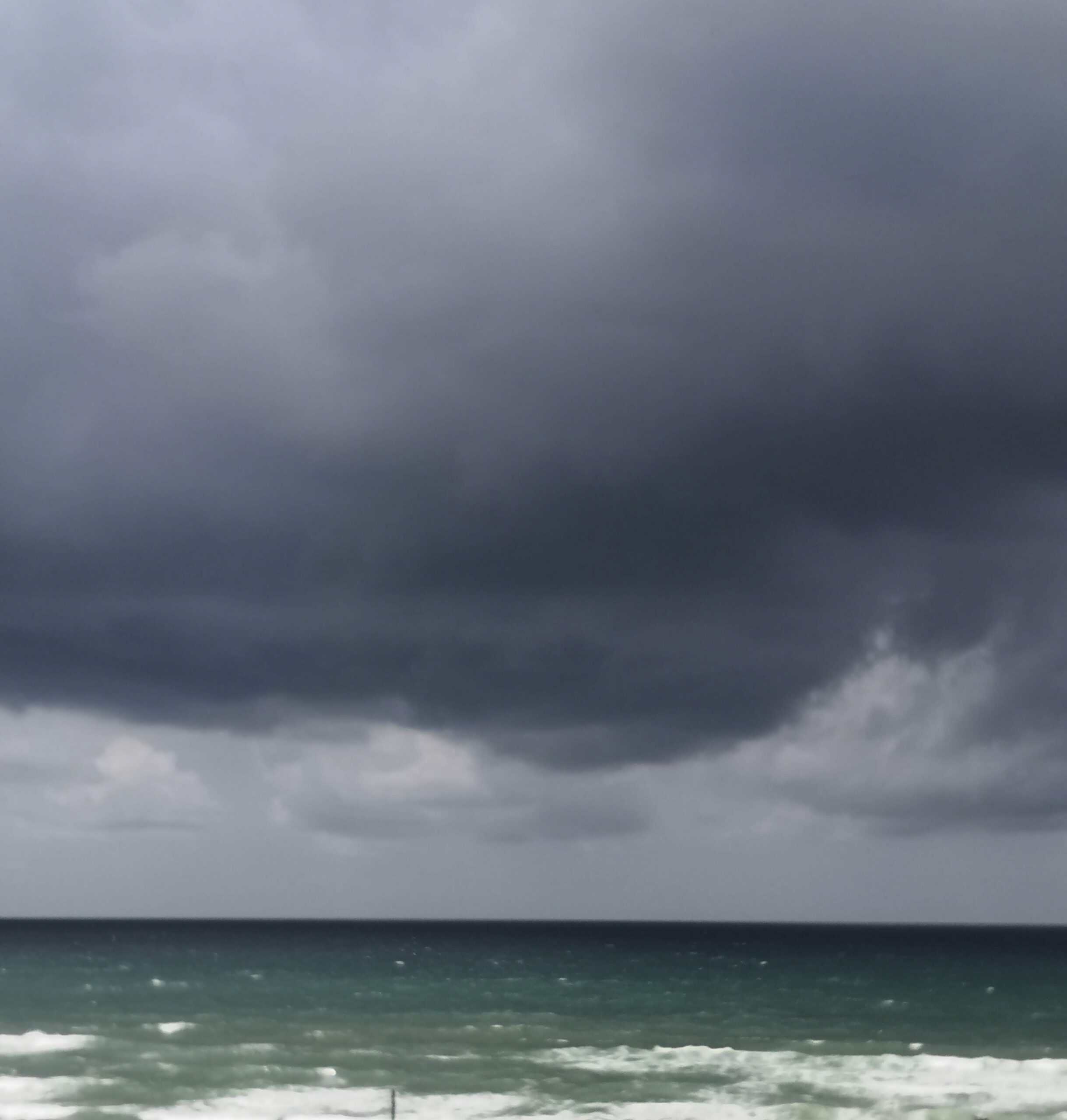
Microbursts and squalls. Sudden, localised wind events that last minutes but can be violent. Watch the sky, not just the app. Dark, anvil-shaped clouds moving fast are a signal to come in regardless of what the forecast says.
Wind shifts. The direction can change 20-30 degrees in minutes at some spots, turning a side-onshore session into a side-offshore one without warning. Know your spot’s shift patterns before you launch — and know what to do if it changes while you’re on the water. The self land guide covers coming in when conditions change unexpectedly.
Best Weather for Kitesurfing — By Rider Level
Complete beginner: Side-onshore, 12-18 knots, gust spread under 5 knots, no swell, uncrowded water. Anything outside this — wait for a better day. The beginners guide covers what conditions your lessons should be in.
Intermediate rider: Side-onshore or side-offshore, 15-25 knots, gust spread under 8 knots. Starting to manage stronger conditions. Still checking direction carefully before committing.
Experienced rider: Comfortable in 10-30 knots across most directions except offshore. Reading gust patterns, thermals, and sea state as part of the session decision. Knows their spots well enough to account for local variations.
Advanced / expert: Reads kitesurfing weather as a complete picture — pressure systems, frontal passage, thermal patterns, sea state. Makes session decisions other riders can’t make safely. Still doesn’t go out in offshore gale conditions. Nobody does.
Quick FAQ
What wind speed is best for kitesurfing?
For most riders on a standard 12m kite — 15 to 22 knots. That’s solid Force 4 to Force 5. Consistent, manageable, enough power to ride well without fighting the kite. The best kitesurfing weather sits in this window for the majority of sessions.
Can I kitesurf in 10 knots?
On a large kite (17m+) or a foil board — yes. On a standard twintip setup with a 12m kite — probably not enough power to ride consistently. Foilers have changed what’s possible in light wind significantly.
How gusty is too gusty for kitesurfing?
If gusts are more than 30-40% above the average — conditions are challenging. For beginners, anything gusty is too gusty. For experienced riders, it’s manageable but demands more active bar control and a cautious approach to launching and landing.
Is offshore wind dangerous for kitesurfing?
Yes — significantly more than other directions. Any gear failure or mistake takes you further from shore. If you ride in offshore kitesurfing weather, you need a practiced self rescue, a support person watching from shore, and a very good reason to be out there.
Which is the best kitesurfing weather app?
Windguru for session planning. Windy for the overall picture. Live local station readings for what’s actually happening right now. Use all three together — no single app gives the complete picture.
I got caught out badly once by a forecast that showed solid Force 5 all day. Arrived at 9am — beautiful. By 11am a thermal had pushed it to Force 7 and the gusts were touching 35 knots. I was on a 12m and had no business being out there.
Came in. Sat on the beach. Watched two other riders have the session of their lives on 7m kites they’d brought as backup.
The forecast wasn’t wrong. I just hadn’t read all of it.
Check the gusts. Check the direction. Check the thermal pattern for the spot. Then decide.
Ride hard. 🤙
Riding a spot with a tricky local wind pattern? Drop it in the comments — local knowledge helps everyone.




I’ve been riding since 2009 — mostly Red Sea and Mediterranean, a season in Tarifa, a few trips to Brazil. I started this site because the maintenance advice online was either vague or wrong, and I got tired of watching riders show up with gear that should have been retired two seasons ago. I fix what other people ignore.