Hey guys.
Kitesurfing Weather reading comes down to three things — read the sea, read the clouds, read the wind. Get those three right before every session and you’ll make better decisions than most riders on the beach.
I’ve been caught in strong wind gusts more than once. Not forecast gusts — the kind that build faster than the apps predicted, that come with a front you didn’t see arriving, that turn a good session into a survival situation. The difference between those sessions and a clean ride home was paying attention to what the sky, the water, and the wind were telling me before I launched.
This Kitesurfing Weather Guide covers everything you need to read kitesurfing weather properly.
Note: This post contains affiliate links. Full Disclosure.
Why Kitesurfing Weather Matters More Than Most Sports
A kitesurfer is directly connected to the wind through a kite generating significant power. When conditions change, that power changes — immediately, and sometimes dramatically. A gust that a cyclist barely notices can double the pull on your kite and put you in the water in seconds.
This is why the Kitesurfing Weather Guide isn’t something you check once and forget. Conditions need to be read before you launch, monitored while you’re riding, and respected when they change.
According to NOAA’s marine weather research, the majority of recreational water sport incidents involving weather occur because riders failed to check conditions before launching or stayed out too long as conditions deteriorated. Kitesurfers are among the most exposed — the kite acts as a powerful sail that amplifies wind changes your body alone would barely feel.
Read the Wind
Wind is the foundation of every kitesurfing weather check. Everything else builds on understanding what the wind is doing.
Direction first. Cross-shore is your friend — wind running parallel to the beach gives you a safe riding lane and keeps you within reach of shore if something goes wrong. Onshore is manageable. Offshore is the one that gets people into serious trouble. Offshore wind means if your kite goes down or you lose your board, you drift away from the beach. I have been in that situation. It is not a place you want to be.
Speed and gusts together. Wind speed alone doesn’t tell you enough. A steady 20 knots is a very different session from an average of 20 knots with gusts to 30. The gap between average and peak tells you how consistent the conditions are. A tight gap — 5 knots or less — means smooth, manageable sessions. A wide gap means the kite is going to be surging and dropping constantly, which is exhausting and harder to control. Use a proper wind forecast app to check both numbers before you go anywhere near your gear.
Thermal wind vs gradient wind. Gradient wind comes from large-scale pressure systems — it’s what the forecast models predict. Thermal wind is local — generated by temperature differences between land and sea, usually building through the afternoon at coastal spots. Thermal wind can add 10 knots to a forecast in a couple of hours. If your spot is known for thermals, factor that into your session planning. A 15-knot morning that turns into 25 knots by 2pm is not unusual at thermal spots.
A wind meter is worth carrying. Estimating wind speed by feel is something that develops over time, but a handheld anemometer gives you an objective reading at the beach before you rig. Useful when conditions look borderline and you’re not sure whether to launch. Get your wind meter here.
Read the Clouds
Clouds are the most underused Kitesurfing Weather Guide tools available to every rider — and they’re free.
Cumulus clouds — the classic white puffy ones — are generally your friend. They indicate convective activity, which often means thermal wind in coastal areas. Watch whether they’re building or dissipating. Building cumulus through the afternoon means conditions are likely to increase. Dissipating cumulus toward evening means the thermal is dying off.
Cumulonimbus — the big dark anvil-shaped storm clouds — are a hard stop. These are thunderstorm clouds. If you can see cumulonimbus developing anywhere on the horizon, get off the water immediately. A kite in the air during a lightning storm is a conductor. This is not a risk anyone should ever take.
High thin cirrus clouds moving in from the west often precede a front by 12 to 24 hours. If you see a milky haze developing across a previously blue sky, check your forecast — a wind shift and pressure change are likely coming.
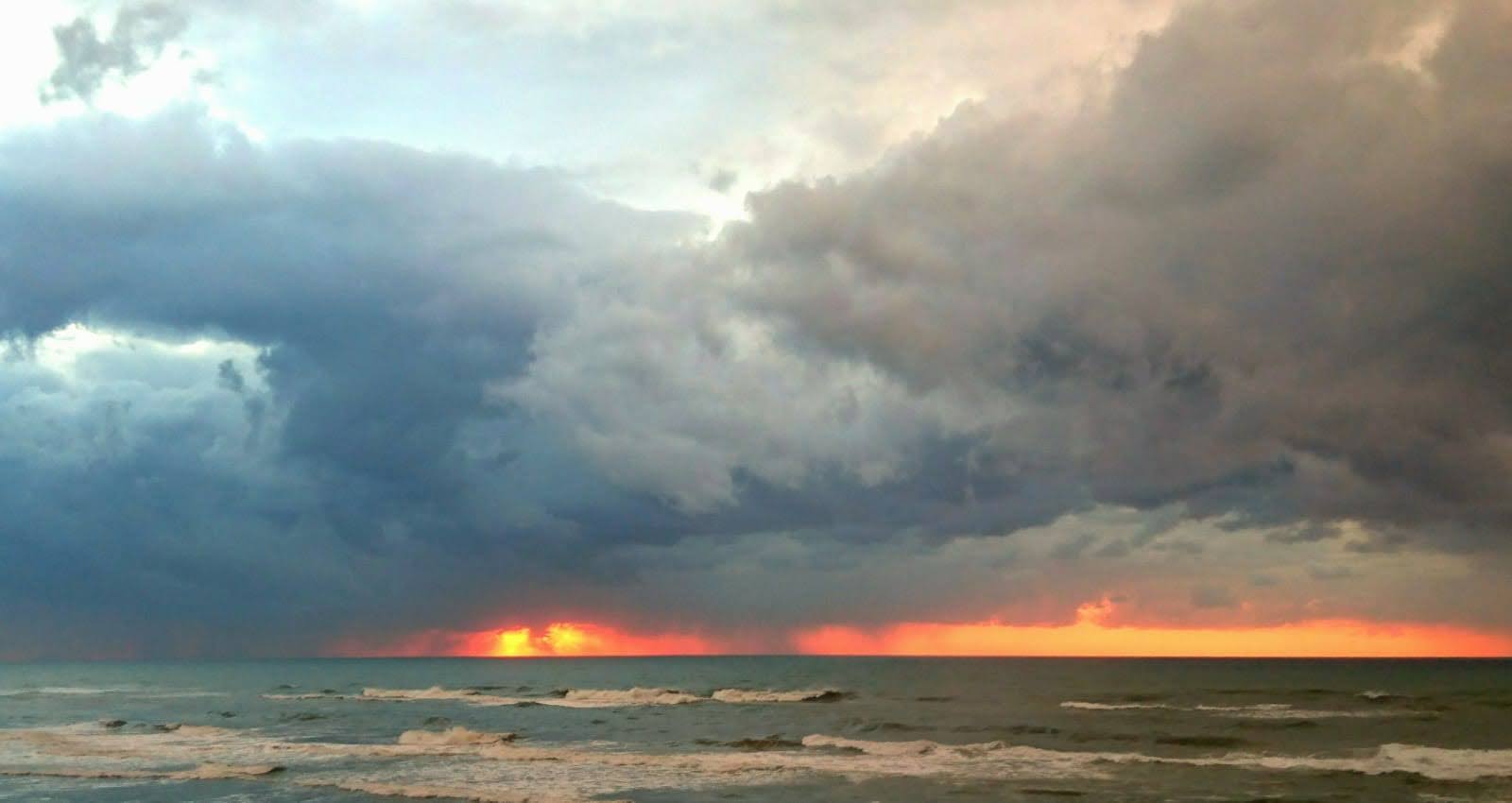
Dark, fast-moving low cloud building quickly is a sign that conditions are about to change significantly. If the sky was clear and low cloud starts appearing and moving fast, start thinking about getting in. That is exactly the kind of thing I missed on the sessions where I got caught in strong gusts. The signs were there. I wasn’t looking at them.
Read the Sea
The water surface tells you what the wind is doing right now — more accurately than any forecast.
Dark patches on the water are where wind is hitting the surface and creating texture. Light patches are lulls. Watching the water tells you what’s coming 30 seconds before it arrives — long enough to position your kite or prepare for a gust.
Whitecaps. When the water starts showing consistent white caps across the bay, conditions are building. Isolated whitecaps in gusts are normal. Solid lines of whitecaps forming everywhere means the wind has stepped up and probably isn’t coming back down. If you’re on the water when this happens, start thinking about coming in rather than waiting to see if it settles.
Chop direction vs wind direction. Chop follows the wind. If the chop is running in a different direction from what you expected based on your forecast, the wind has shifted. A shift you didn’t predict is worth pausing for — especially if it’s moved toward offshore.
Current patterns. Rip currents, tidal flows, and longshore drift all affect your session and your safety. At tidal spots, the current at high tide and low tide can be completely different. Know your spot. If you’re somewhere new, ask a local rider before you launch. Current has put riders in situations no amount of kite skill could get them out of.
Best Kitesurfing Weather Conditions
For most riders, the ideal kitesurfing weather looks like this:
Wind: 15 to 25 knots, cross-shore or cross-onshore, with gusts no more than 5 to 7 knots above average. Consistent and steady rather than puffy and variable.
Wind direction: Cross-shore. Slight onshore component is fine. Any offshore component requires extra caution and solid self-rescue skills.
Sky: Partly cloudy to sunny, no cumulonimbus or fast-moving low cloud. Stable pressure, no fronts expected in the session window.
Sea state: Moderate chop appropriate to the wind, no large shore break that would make launching and landing dangerous. Whitecaps present but not solid across the bay.
Tide: Depends entirely on your spot. Some beaches are flat at low tide and have shore break at high. Know your spot’s tidal patterns and plan your session accordingly.
Kitesurfing Weather Red Flags — When Not to Launch
Some conditions are obvious. Some are not. These are the ones worth knowing before they catch you out.
Offshore wind. Already covered — but worth repeating. If the wind is blowing from land to sea at your spot, the risk profile of every bad scenario changes dramatically.
Rapidly building conditions. A forecast of 18 knots that arrives showing 25 is telling you something. Don’t launch just because you drove to the beach. Conditions that are building rapidly will keep building. Wait and watch, or go home.
Thunderstorms anywhere on the horizon. Not approaching, not forecast — anywhere visible. Land immediately. No session is worth a lightning strike.
Unstable, puffy wind. Variable direction, wide gust gaps, frequent lulls. This is more tiring and harder to manage than steady strong wind. Beginners especially should wait for cleaner conditions rather than fighting inconsistency for a whole session.
Fog. Fog reduces visibility dramatically. Riding in fog means you can’t see other water users, you can’t see hazards, and rescue services can’t see you if something goes wrong. Don’t launch in fog.
The kitesurfing safety guide covers what to do when conditions change while you’re already on the water.
The Kitesurfing Weather Guide — Full Detail on Each Topic
This pillar covers the big picture. Every topic below has a dedicated guide with the full detail:
- Kitesurfing Weather — full session weather planning, forecasting tools, reading a spot
- Kitesurfing Wind Window — how the wind window works and why it matters for every session
- Wind Forecast App Kitesurfing — the best apps and how to use them together
FAQs
What is the best weather for kitesurfing?
The best kitesurfing weather is 15 to 25 knots of cross-shore or cross-onshore wind, with gusts no more than 5 to 7 knots above the average. Stable sky, no approaching fronts, and sea state appropriate to the wind. Consistency matters more than raw speed — a steady 18 knots is a better session than a gusty 22.
How do you read wind for kitesurfing?
Check direction first — cross-shore is safest, offshore is dangerous. Then check speed and gusts together using a forecast app. At the beach, watch the water surface for dark patches showing where wind is hitting, and watch the sky for building cloud or signs of a front approaching. A handheld anemometer gives you an objective reading before you rig.
Is offshore wind dangerous for kitesurfing?
Yes — especially for beginners. Offshore wind means that if something goes wrong, you drift away from shore rather than toward it. A downed kite, a lost board, or a safety release in offshore wind puts you in a much more serious situation than the same incident in cross-shore conditions. Beginners should never kitesurf in offshore wind.
What clouds should kitesurfers watch for?
Cumulonimbus — large, dark, anvil-shaped storm clouds — mean get off the water immediately. High cirrus clouds moving in from the west often precede a front. Fast-moving low cloud building quickly is a sign conditions are about to change. Cumulus building through the afternoon at a thermal spot usually means wind is increasing.
How do you check kitesurfing weather before a session?
Use a wind forecast app — WindGuru, Windy, or Windfinder — to check wind speed, gusts, and direction. At the beach, verify direction and consistency visually, check the water surface for wind patterns and whitecaps, and assess the sky for any signs of approaching weather. Cross-referencing two apps that agree gives you the most reliable picture.
What wind speed is too strong for kitesurfing?
It depends on your experience and kite size. For most beginners, above 25 knots is too much on a standard beginner kite. For intermediate riders, above 30 to 35 knots requires a smaller kite and solid skills. The gust factor matters as much as the average — strong but consistent wind is more manageable than lower average wind with large unpredictable gusts.
Ride hard. 🤙




I’ve been riding since 2009 — mostly Red Sea and Mediterranean, a season in Tarifa, a few trips to Brazil. I started this site because the maintenance advice online was either vague or wrong, and I got tired of watching riders show up with gear that should have been retired two seasons ago. I fix what other people ignore.