Hey guys.
Kite lines wear out gradually and mostly invisibly — until they don’t. A line that looks fine from a distance can be critically weakened at the connection points where you can’t easily see it. As a kite mechanic, lines are one of the first things I check on any kite that comes through my hands, and most riders have no idea how worn theirs are.
Here’s how to do a proper kite lines wear check and what you’re looking for.
Note: This post contains affiliate links. Full Disclosure.
What Is Kite Lines Wear?
Kite lines wear is the progressive degradation of Dyneema flying lines through UV exposure, salt, abrasion, and repeated load cycles. Dyneema is extremely strong — according to DSM Dyneema, the fibre has a strength-to-weight ratio fifteen times higher than steel — but it does degrade over time, and the failure almost always happens where the line wraps around a pigtail or passes through a pulley, not along the visible length riders can easily see.
The dangerous thing about kite lines wear is that degraded lines don’t look broken. They look fine — until the load of a jump or a gust pushes them past what’s left of their rated strength. A line snapping mid-session is not just inconvenient. It’s a genuine safety event.
Where Do Kite Lines Wear Fastest?
The answer is almost always the same, and in 20 years of checking and fixing kites, this pattern never changes: the connection points.
The pigtail connections — where your flying lines attach to the kite’s bridle — take enormous repeated stress every session. The line wraps around the knot under load, salt crystals accumulate in the weave, and the coating that protects the Dyneema core wears through faster here than anywhere else. Run your fingers along the line from bar to kite and you’ll feel it before you see it — a roughness or stiffness right at the pigtail wrap that isn’t there on a healthy line.
The same applies anywhere a line passes through a pulley or is regularly crossed with another line during riding. Every crossing under power is friction. Over a season of riding, that friction removes the coating and weakens the core.
Front lines wear differently from steering lines. Front lines are under near-constant high tension — they stretch and, over time, actually shrink through a process of braid tightening as the coating degrades. According to Liros GmbH, a major Dyneema kite line manufacturer, steering lines can shrink up to 20 centimetres over a season of use. This is worth knowing because it affects kite trim as much as it affects line safety — uneven line lengths from differential wear are a common cause of kites that handle strangely or feel underpowered.
How to Check Kite Lines for Wear?
This is the check I run on every set of lines I inspect. Takes about ten minutes. Do it at the start of every season and after any session that involved hard crashes or sand dragging.
The hand check first. Lay all four lines out straight on clean ground — not sand, not concrete. Run the full length of each line through your fingers slowly. What you’re feeling for: roughness, stiffness, any change in texture compared to the rest of the line. A healthy Dyneema line feels smooth and consistent. Kite lines wear shows up as a grainy or fuzzy texture where the coating has gone. Any roughness at all is worth marking and watching.
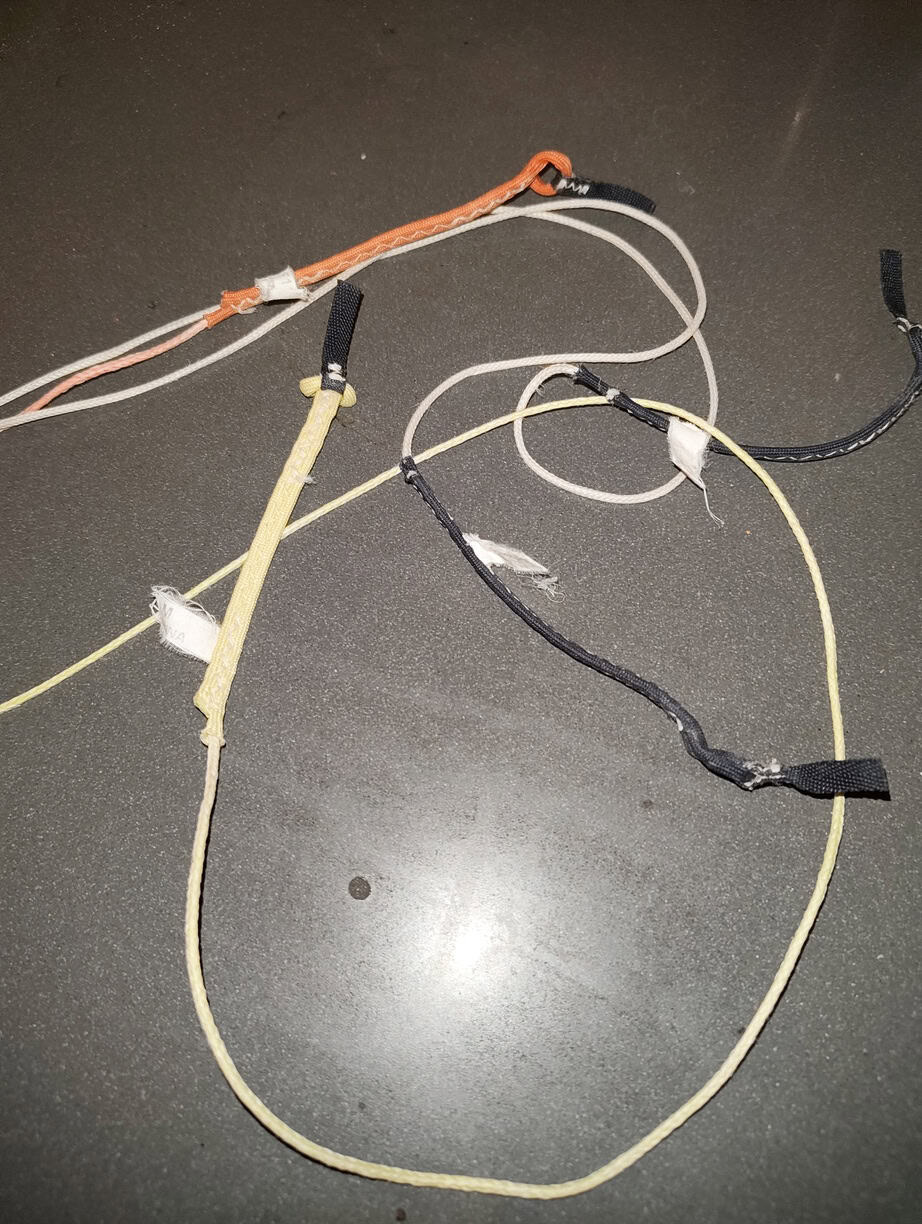
The pigtail connection check. This is the most important part. At each end of each line, where the line loops around the pigtail, look closely and feel carefully. This is where kite lines wear concentrates. Fuzzing, discolouration, any visible fraying or splaying of the fibres — these are not cosmetic. A frayed connection point is a line that is close to failing.
The length check. Hook your bar to a fixed point — a fence post or bar stool — and pull all four lines out to equal tension. The tips should all reach the same point. If your front lines are shorter than your steering lines (or vice versa), differential wear or shrinkage has changed your setup. This explains why the kite might have started feeling different even if the lines look okay.
Knots. Any knot anywhere in a line is a problem. A knot in a Dyneema line reduces its rated breaking load by up to 50%. If a line has a knot that wasn’t there when you bought it, either the line has been damaged and tied back together — which is not a safe repair — or something has tangled and tightened. Either way, that line needs replacing.
What Are the Signs That Kite Lines Need Replacing Immediately?
Some things are watch-and-monitor. These are not:
Any visible fraying at a pigtail connection. Not “keep an eye on it” — replace the set. Fraying at the connection point means the outer fibres of the braid have already failed. What’s left holding the load is less than what the line was rated for.
Any knot in a flying line, for the reasons above.
A line that snapped and was tied back together. Full stop — never fly a knotted repair on a flying line.
Lines that are more than two to three seasons old on a rider who sessions frequently. Dyneema degrades from UV exposure and salt even when lines look externally clean. After two seasons of regular use, the coating is typically gone and the raw fibre is what you’re flying on.
How Often Should You Check Kite Lines for Wear?
A full hand check at the start of every season. A quick pigtail inspection every five to ten sessions. After any hard crash that involved dragging on beach or rocks — immediately.
Most riders never check their lines until something goes wrong. The check takes ten minutes. A line snapping mid-session costs you a session, possibly equipment, and in a worst case — as one rider on Seabreeze forums described after snapping a front line during a kiteloop — four broken ribs.
The kite maintenance calendar in the Mechanic’s Workshop lays out the full schedule for what to check and when. Lines sit at the top of that list for a reason.
Key Takeaways
- Kite lines wear concentrates at pigtail connection points and pulley contact areas — not along the visible length
- Run your fingers along the full length of each line every season — feel for roughness, stiffness, or texture change
- Front lines stretch and steering lines shrink at different rates — check lengths against each other at the start of each season
- Any knot in a flying line reduces breaking load by up to 50% — do not fly a knotted line
- Visible fraying at a connection point means immediate replacement — not monitoring
- Lines more than two to three seasons old on a regular rider should be replaced regardless of visual appearance
- The check takes ten minutes — do it before every season and after hard crashes
FAQs
How do I check kite lines for wear?
Run your fingers slowly along the full length of each line feeling for roughness or texture changes. Inspect pigtail connection points closely — this is where kite lines wear fastest. Check all four line lengths against each other by hooking the bar to a fixed point and pulling to equal tension. Any roughness at connections, visible fraying, or significant length differences means the lines need attention.
When should I replace my kite lines?
Replace immediately if you find fraying at a pigtail connection, any knot in a flying line, or lines that were previously snapped and tied. For regular riders, replace every two to three seasons regardless of visual appearance — Dyneema degrades from UV and salt even when lines look clean externally.
Can kite lines snap without warning?
Yes — kite lines wear happens invisibly at the connection points and inside the braid coating. A line can look clean along its length while being critically degraded at the pigtail wrap. This is why a hands-on inspection is more reliable than a visual check alone.
Do kite lines stretch or shrink over time?
Both, and they do it differently. Front lines stretch under constant high load. Steering lines shrink as the braid coating degrades — according to Liros GmbH, a major kite line manufacturer, steering lines can shrink up to 20cm over a season of use. This differential change is why length-checking all four lines against each other matters as much as checking for physical wear.
How long do kite lines last?
For a rider who sessions several times a week, one to two seasons before the first signs of significant wear appear at connection points. With careful maintenance — fresh water rinse after every salt session, no sand dragging, storage uncoiled — lines can last two to three seasons. After that, replace regardless of appearance.
What does a worn kite line feel like?
Rough, slightly stiff, or fuzzy compared to the rest of the line — particularly at pigtail connections. Healthy Dyneema feels smooth and consistent. Once the outer coating has worn away the exposed fibres feel noticeably different. If you’re in doubt about what you’re feeling, compare the suspect section to an area well away from any connection point.
When did you last check yours? If you can’t remember — that’s your answer. Drop any questions in the comments.
Ride hard. 🤙




I’ve been riding since 2009 — mostly Red Sea and Mediterranean, a season in Tarifa, a few trips to Brazil. I started this site because the maintenance advice online was either vague or wrong, and I got tired of watching riders show up with gear that should have been retired two seasons ago. I fix what other people ignore.