Hey guys.
If you want to know how to store a kite properly, the answer is simple: clean it, dry it completely, pack it loosely, and keep it somewhere cool and dark. Everything else is detail on those four things.
Most kite damage I see in the workshop didn’t happen on the water. It happened in someone’s garage, shed, or car boot over the winter. The kite sat somewhere it shouldn’t have, got hot, stayed damp, or got folded too tight — and came out in spring already broken.
Note: This post contains affiliate links. Full Disclosure.
What Is Kite Long Term Storage?
Storing a kite long term means putting it away for weeks or months — usually the off season — in a way that it comes out in the same condition it went in. The enemies are heat, sun, moisture, and sustained pressure at fold points. According to NOAA research on UV polymer degradation, UV radiation breaks down synthetic materials at the molecular level even through diffuse light — a window, a translucent shed roof, a car windscreen. Over months, that adds up.
Why Does Heat Destroy a Stored Kite?
This is the big one. A car parked in sun hits 60 to 80 degrees Celsius inside within an hour. At those temperatures, TPU bladder material softens and deforms. It doesn’t snap or burst — it quietly loses its elasticity while sitting in a bag. The bladder that held pressure perfectly last season develops inexplicable leaks before you’ve even got to the beach.
Heat damage from storage is some of the most frustrating damage to deal with because it’s completely invisible until the kite is already compromised. The bladder loses elasticity. The canopy coating degrades. None of it shows up as an obvious crack or tear — it shows up as a kite that inexplicably leaks, handles differently, and generally feels like it’s aged two seasons in one winter.
The car boot is the most common storage mistake and the easiest one to avoid. It takes no more effort to bring the kite inside than leave it in the car. Just bring it inside.
Does It Matter If the Kite Is Damp When You Pack It?
Yes — more than most people realise.
Salt water and moisture packed into a bag together over months is a recipe for mould. Mould in a kite canopy doesn’t just look bad — it degrades the fabric coating from the inside out, in the folds where you can’t see it until it’s already done serious damage.
Rinse the kite with fresh water after the last session of the season. The whole thing — canopy, leading edge, struts, and especially the valve areas. Salt crystals left around a valve slowly work into the seal over months and cause leaks that appear for no obvious reason in spring.
Then actually let it dry. Both sides. Laid out flat in shade — not in sun, UV on a wet canopy is its own problem. Don’t pack it damp because you’re in a hurry. If it’s not dry it doesn’t go in the bag yet.
The full guide on how to clean a kite after a session covers exactly what to do before any gear goes into storage.
How Tight Should You Pack a Kite for Storage?
Loose. Much looser than most riders pack it.
Tight packing feels organised but it’s actually slow damage. A bladder creased hard and left under sustained compression for four months develops a weakness exactly at the crease. That’s why you get pinhole leaks at fold points — they didn’t come from a wipeout, they came from winter storage.
Roll from the wingtips toward the centre strut — the kite folding guide shows the technique. And then leave the bag comfortably full rather than compressed. If it’s in there for three months or more, pull it out halfway through and repack it so the fold points are in different positions. Twenty minutes, halves the sustained pressure on any single crease.
If you have the space, store it partially inflated — just enough pressure to hold the shape. No fold points at all. Best possible option for the bladder. Not practical for most people, but worth knowing.
The same packing principles apply when travelling — the kitesurfing travel bag guide covers how to pack for a flight without damaging your gear.
Where Is the Right Place to Store a Kite?
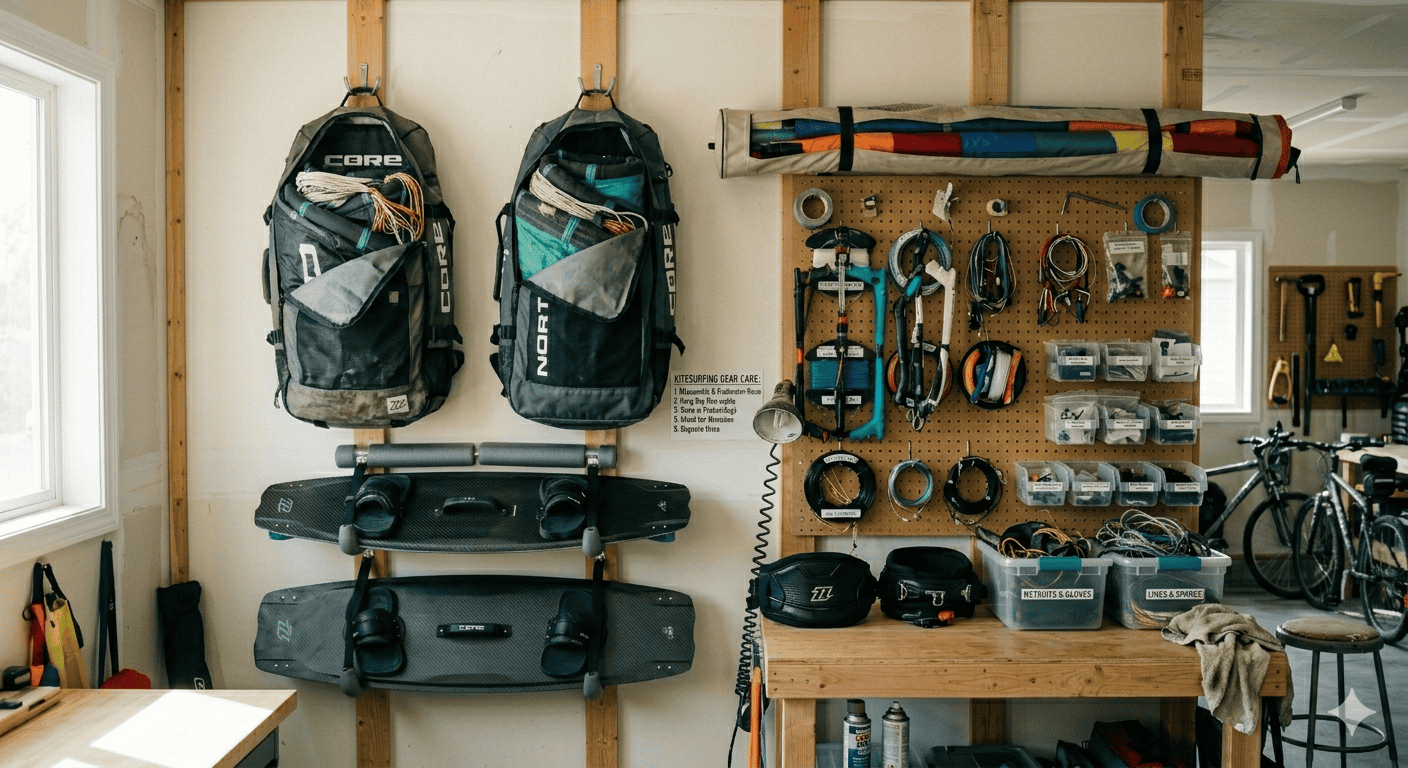
Somewhere cool, dry, dark, and stable in temperature. An indoor cupboard, a climate-controlled room, an insulated garage away from exterior walls — all fine.
The places that look fine but aren’t: a garden shed with a metal roof gets brutally hot in summer, same as the car. An attic has the same temperature problem plus UV through roof panels. Anywhere damp is as damaging as heat over a long storage period.
If those are your only options, put something between the kite bag and the hottest surfaces, and check on it every few weeks rather than leaving it completely untouched until spring.
What About the Bar and Lines?
The bar and lines need the same end-of-season attention as the kite. Most riders pack the bar away without rinsing it and then wonder why things don’t work properly in spring.
Flush the bar with fresh water — not just the outside, but through the depower cleat mechanism. Salt crystals in that cleat over winter seize it solid. A trim strap that won’t move in spring is a very common problem and almost always comes from a bar that went into storage without being flushed. Ten minutes with fresh water and a light silicone spray on the moving parts before storage prevents this entirely. The kite bar maintenance guide covers the full process.
Lines — coil them loosely and don’t leave them under tension on the bar over winter. Sustained tension on coiled Dyneema over months contributes to the braid changes that affect line length and performance. According to Liros GmbH, one of the main Dyneema kite line manufacturers, steering lines can shrink up to 20 centimetres over a season of heavy use — storage under tension only accelerates this. Details in the kite lines wear check guide.
Key Takeaways
- Cool, dry, dark, stable temperature — the four requirements to store a kite properly
- Heat is the number one enemy — a car boot in summer does more damage than a full season of riding
- Rinse with fresh water and dry completely before packing — salt and moisture cause mould and valve leaks
- Pack loosely — tight compression at fold points causes bladder leaks the following season
- Repack partway through a long off season to move the fold points
- Fix small canopy damage before packing — it gets worse in storage
- Bar and lines need the same treatment — flush the cleat, coil lines loose
FAQs
How to store a kite for the off season?
Rinse it with fresh water, dry it completely, fix any small damage, then pack it loosely and store somewhere cool, dark and dry. Avoid hot cars, garden sheds, and attics. If storing for more than three months, repack halfway through to change the fold point positions.
Can you store a kite in a car?
Not if it gets hot. A car in direct sun reaches 60 to 80 degrees Celsius inside — enough to permanently deform bladder material and degrade canopy coatings. Short overnight trips are fine. Weeks or months in a hot car will visibly age a kite by years.
How long can you store a kite?
A clean, dry, loosely packed kite stored somewhere cool and dark can last a full season or longer in storage without significant degradation. The main risks are bladder compression damage and UV exposure. Inspect and inflate fully before the first session of every new season.
Should you store a kite inflated or deflated?
Partially inflated is best if you have the space — it removes fold points entirely. Deflated and loosely packed is the standard practical option. Never tightly compressed — sustained pressure at fold points causes bladder leaks over months.
What temperature is too hot to store a kite?
Sustained temperatures above 40 degrees Celsius begin to stress TPU bladder material. A car or shed in direct sun can reach well beyond that. Indoors at normal room temperature is fine — the goal is avoiding extreme heat and temperature swings, not perfect climate control.
How do you know if your kite has been damaged in storage?
Inflate fully and watch for pressure loss over 30 minutes. Check valve points for salt residue or leaking. Look for any new discolouration, cracking, or unusual stiffness in the canopy. Run your fingers along line connection points for roughness. Any issues found before the first session are much easier to fix than ones discovered mid-ride.
Where do you keep your kite over winter? Drop it in the comments — always curious what setups people are actually working with.
Ride hard. 🤙




I’ve been riding since 2009 — mostly Red Sea and Mediterranean, a season in Tarifa, a few trips to Brazil. I started this site because the maintenance advice online was either vague or wrong, and I got tired of watching riders show up with gear that should have been retired two seasons ago. I fix what other people ignore.