Hey guys.
Wing foiling vs kitesurfing — two different sports that use the same element, wind, and deliver completely different experiences on the water. The honest answer to which one you should learn depends on where you ride, what you want from it, and how much patience you have for a learning curve.
I kitesurf. I haven’t tried wing foiling. That makes me biased toward kitesurfing in some ways — and actually more useful in others, because I’m not trying to sell you either one.
Note: This post contains affiliate links. Full Disclosure.
What Is the Difference Between Wing Foiling and Kitesurfing?
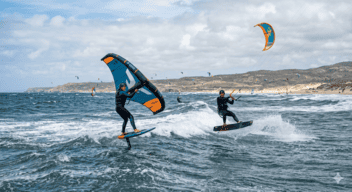
Wing foiling uses a handheld inflatable wing — you hold it directly, no lines, no bar, no harness — and ride a hydrofoil board that lifts above the water once you’re up to speed. Kitesurfing uses a large kite flying 20-25 metres above you, connected via lines to a bar and harness, pulling you across the water on a twin-tip or directional board.
The feel is completely different. Kitesurfing is powerful, fast, and pulls you. Wing foiling is quieter, floatier, and once on the foil, almost silent. According to ENSIS Academy, riders who’ve done both often describe kitesurfing as the sport for adrenaline and wing foiling as the sport for flow. That’s a fair summary.
Which Is Easier to Learn — Wing Foiling or Kitesurfing?
Wing foiling is generally easier to start. Most beginners get riding on the board in their first session. No kite control to master, no lines to manage, no launch procedure. You walk in from the beach, pick up the wing, and start. The entry point is lower.
But — and this matters — getting on the foil takes time. Once you’re riding the board comfortably, learning to get the foil flying and stay balanced on it is its own steep progression. Riders who breeze through the first stage often find the foiling stage surprisingly demanding.
Kitesurfing is harder to start. The kite control, the body drag, the water starts — all of that has to come together before you’re independently riding. Most riders reach that point after 10-15 hours of proper instruction. The kitesurfing learning curve guide covers it in detail. But once you’re riding, the progression opens up fast — upwind, jumps, waves, foiling — the kite gives you access to a huge range of disciplines from the same base skill.
If someone asks me which sport gets them on the water feeling good faster — wing foiling. If they ask which sport keeps them engaged for longer — that’s harder to answer, and probably personal.
Which Is More Expensive — Wing Foiling or Kitesurfing?
Roughly the same, which surprises most people.
Kites are more expensive than wings. Wing foil boards are more expensive than twin-tips. It roughly balances out at the entry level — both sports cost around €2,500-3,500 for a complete beginner setup. Where the costs diverge is over time. Kitesurfing tends to push you toward multiple kite sizes — you’ll want a bigger kite for light wind and a smaller one for strong days. Wing foiling tends to push you toward foil upgrades — different wing sizes, mast lengths, fuselage options.
Lines wear out in kitesurfing and need replacing. Wings are generally lower maintenance than kites. Bar and harness add cost that wing foiling doesn’t have. On the other hand, foil components are expensive when they do need replacing.
The honest take: budget similarly for starting either sport, then expect ongoing gear evolution in both.
Where Can You Ride — Does Location Change the Decision?
Yes — and this is one of the most underrated factors in the wing foiling vs kitesurfing decision.
Kitesurfing needs space. A wide open beach, clear of obstacles, with a safe launch and landing zone. The kite is 25 metres up and the lines extend further than most people realise. Crowded beaches, narrow spots, harbours, offshore wind situations — kitesurfing becomes difficult or impossible. The kitesurfing safety guide covers exactly why location and launch conditions matter so much.
Wing foiling needs almost no space. You walk in from anywhere — a rocky shore, a narrow beach, a harbour wall. No launch procedure, no lines sweeping across the beach. It works in offshore wind where kitesurfing would be dangerous, in gusty conditions where a kite would be unpredictable, in locations where kitesurfing is restricted or banned. If you live somewhere without a classic kite beach, that’s a real consideration.
If your nearest spot is a big open beach with consistent cross-shore wind — kitesurfing makes sense and gives you more. If your nearest spot is a small lake, a harbour, or an exposed rocky coast — wing foiling might be the only practical option.
Which Sport Is Safer for Beginners?
Wing foiling has a lower immediate risk profile. No lines, no kite overhead, no launch and landing dynamics. If the wing drops, you’re just a person standing on a board in the water. You can paddle back to shore. The consequences of mistakes are lower, especially early on.
Kitesurfing has more safety systems — depower straps, quick releases, safety lines — but those systems exist because the consequences of getting it wrong are higher. A poorly managed kite in strong wind is a genuine hazard. That’s why certified instruction is non-negotiable for kitesurfing in a way it isn’t quite as critical for wing foiling. The IKO is the international body that certifies kitesurfing instruction globally — any school worth booking teaches you the safety systems before anything else.
Neither sport is dangerous with proper instruction and appropriate conditions. But the margin for error is wider in wing foiling, which matters for beginners who are still working things out.
Who Is Each Sport For?
After 20 years on the water and watching both sports grow, here’s my honest read.
Kitesurfing suits riders who want power, speed, and long-term progression. The learning curve is steeper but the ceiling is higher — there’s always something new to learn, always a new discipline to explore. Wave riding, freestyle, big air, foiling — all accessible from the same kite. It’s the sport that keeps experienced riders engaged for decades. If you’re competitive, if you want to push performance, if you’re drawn to the technical side of gear — kitesurfing is probably your sport.
Wing foiling suits riders who want to get on the water with less friction and more flexibility. Less gear, less setup, more locations, lower initial risk. If you’re somewhere without a classic kite beach, if the idea of managing lines and a launch procedure puts you off, if you want something quieter and more meditative — wing foiling makes sense. It’s also a genuinely interesting progression for experienced kitesurfers who want something different on days when the kite beach isn’t working.
The honest answer to wing foiling vs kitesurfing is that they’re not really competing. Most riders who go deep into one end up curious about the other.
Key Takeaways
- Wing foiling is easier to start — no lines, no kite control, lower barrier to first session
- Kitesurfing takes longer to learn but the progression ceiling is higher
- Both sports cost roughly the same to start — around €2,500-3,500 for a full beginner setup
- Wing foiling works in more locations — no launch space needed, offshore wind is fine
- Kitesurfing needs open space, consistent cross-shore wind, and a proper launch zone
- Wing foiling has a lower immediate risk profile — easier to self-rescue, no lines
- Kitesurfing opens up more disciplines long term — freestyle, big air, waves, foiling all from the same kite
- Most riders who go deep in one end up curious about the other — they’re complementary, not competing
FAQs
Is wing foiling easier than kitesurfing?
Wing foiling is easier to start — most beginners get riding in their first session without needing to master kite control first. Kitesurfing has a steeper entry learning curve but rewards that investment with faster progression into high-performance riding once the basics click.
How much does wing foiling cost compared to kitesurfing?
Both sports cost roughly the same to start — around €2,500 to €3,500 for a complete beginner setup. Kites are more expensive than wings, but wing foil boards are more expensive than kiteboards. Ongoing costs differ — kitesurfing pushes toward multiple kite sizes, wing foiling toward foil component upgrades.
Can you kitesurf and wing foil at the same spot?
Often yes, though kitesurfing requires more launch space and won’t work in offshore wind or tight locations where wing foiling is fine. Many kite beaches are also used by wing foilers, but wing foilers have access to spots that are genuinely off-limits to kitesurfers.
Should I learn wing foiling or kitesurfing first?
It depends on your location and what you want from the sport. If you have a classic kite beach nearby and want power, speed, and long-term progression — start with kitesurfing. If your riding location is limited, if you want lower risk and faster initial access to the water — wing foiling makes sense. Both are worth learning eventually.
Is wing foiling safer than kitesurfing?
Wing foiling has a lower immediate risk profile for beginners — no lines, easier self-rescue, smaller margin for dangerous mistakes. Kitesurfing requires more respect for the equipment and conditions, which is why proper certified instruction is essential. With the right instruction, both sports are safe.
Can a kitesurfer learn wing foiling easily?
Yes — kitesurfers already understand wind, water reading, and board feel. The transition to wing foiling removes the kite complexity and adds the foiling challenge. Most experienced kitesurfers pick up wing foiling faster than complete beginners because the water skills transfer directly.
Are you a kitesurfer who’s tried wing foiling, or a wing foiler thinking about picking up a kite? What was the crossover like — drop it in the comments.
Ride hard. 🤙




I’ve been riding since 2009 — mostly Red Sea and Mediterranean, a season in Tarifa, a few trips to Brazil. I started this site because the maintenance advice online was either vague or wrong, and I got tired of watching riders show up with gear that should have been retired two seasons ago. I fix what other people ignore.