Foiling has changed the way we ride. Hydrofoil allows kitesurfers to glide above the water, ride in lighter wind, and travel at higher speeds than traditional twintip riders. But with that performance advantage comes added responsibility.
Understanding kitesurfing right of way rules for foilers is critical for safety, especially in crowded spots. Because foilers move faster, point higher upwind, and carry underwater wings, small mistakes can quickly become dangerous.
Whether you’re riding flat water, swell, or busy lagoons, this guide explains exactly how right of way rules apply to foilers—and how to ride safely and respectfully.
This post is part of the complete kitesurfing safety guide.
Note: This post contains affiliate links. Full Disclosure.
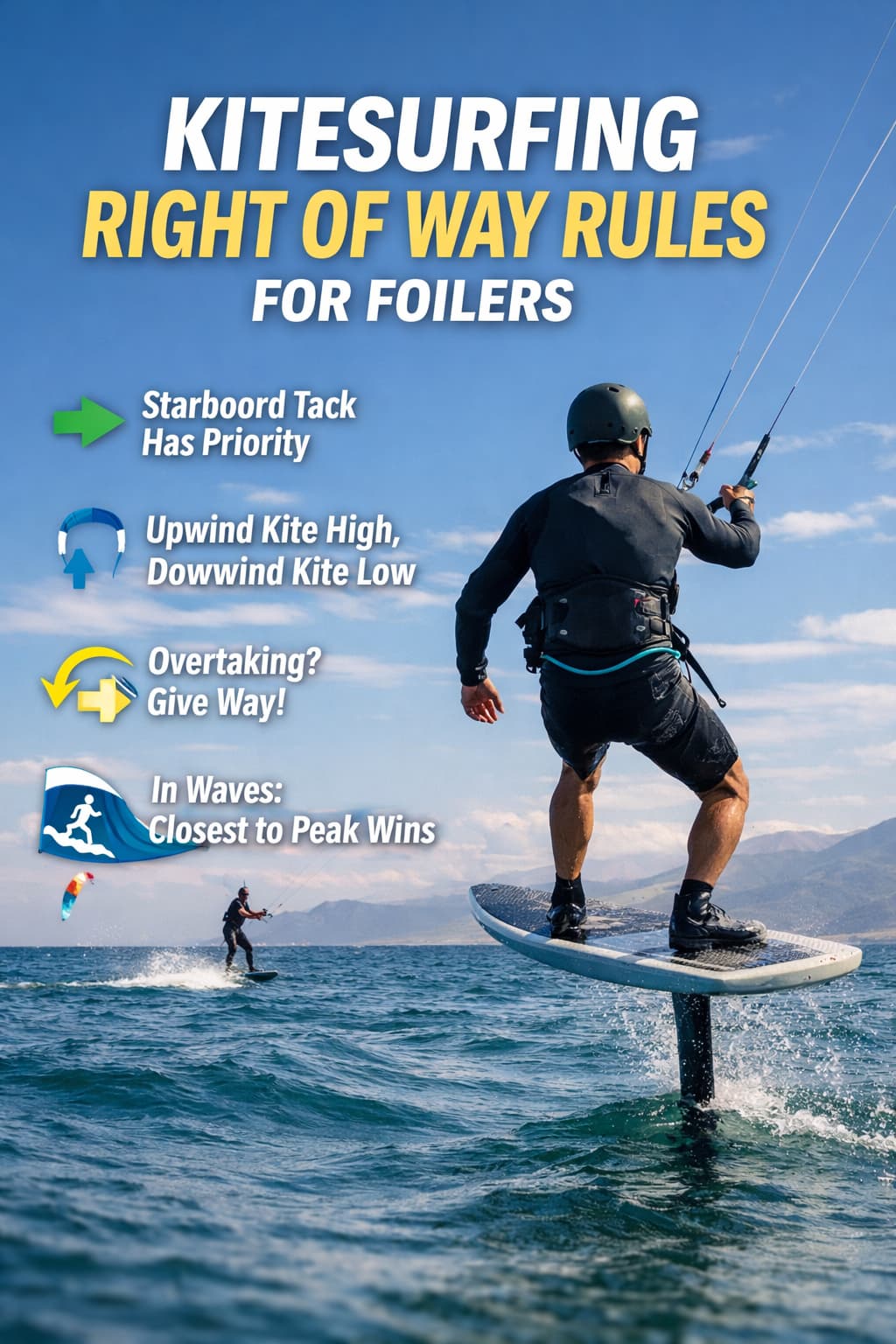
Kitesurfing Right of Way Rules for Foilers — The Main Principles
The fundamental right of way rules in kitesurfing apply to all riders, including hydrofoil riders. However, how those rules are applied changes slightly due to speed and maneuverability differences.
Here are the universal rules every foiler must follow.
1. Starboard Tack Has Priority
If two riders approach each other on opposite tacks:
- The rider with the right hand forward is on starboard tack.
- The rider on starboard tack has right of way.
- The rider on port tack must give way.
Wish that this would happen in reality since this rule applies regardless of board type—twintip, directional, or foil.
2. Upwind Rider Keeps the Kite High
When riding in the same direction:
- The upwind rider keeps their kite high.
- The downwind rider keeps their kite low.
This will prevents line tangles and reduces collision risk.
While surfing, it happens to me all the time: suddenly, a foil crosses me with a low kite, which can be stressful. For foilers, this is especially important because crossing lines at higher speeds increases danger.
3. The Overtaking Rider Must Keep Clear
If you’re coming from behind:
- The overtaking rider must avoid the rider ahead.
- The rider in front has priority.
Since foilers are usually faster, this rule applies frequently to you.
4. The Rider Entering the Water Yields
If someone is launching or water-starting:
- The rider already riding has priority.
- The launching rider must wait for a safe opening.
Foilers must be extra cautious because their mast and wings extend underwater.
Foiler vs Twintip: Who Yields?
Technically, the same right of way rules apply to both riders. But in real-world situations, speed and angle differences can create confusion.
Foilers often:
- Ride faster
- Point higher upwind
- Maintain speed in light wind
- Approach at unusual angles
Even if you technically have priority, forcing another rider into a panic maneuver is bad etiquette.
Best practice for foilers:
If you are the faster rider, plan your avoidance early.
Being right is less important than being safe.
Speed Differential: The Biggest Risk Factor
One of the most important aspects of kitesurfing right of way rules for foilers is understanding speed difference.
Foilers can cruise comfortably at 20+ knots. Twintip riders may be traveling much slower.
This means:
- You close distance quickly.
- Other riders may not realize how fast you’re approaching.
- Reaction time is reduced.
If you are overtaking, the responsibility is yours—even if you are on starboard tack.
Defensive riding prevents accidents.
Hydrofoil Right of Way in Waves
Wave riding introduces another layer of priority rules.
Wave Priority Rule
The rider closest to the peak or first on the wave has right of way.
This applies to:
- Twintip riders
- Directional riders
- Foilers
However, foilers often catch swell earlier and ride longer lines.
When foiling waves:
- Avoid cutting back toward other riders.
- Maintain predictable lines.
- Exit the wave early if traffic is heavy.
Your carving radius is larger than most riders expect.
Tacking and Jibing on a Foil
Foilers often tack instead of jibe. During transitions:
- Speed drops temporarily.
- Kite position changes.
- Balance becomes more delicate.
Before initiating a tack:
- Check both shoulders.
- Confirm space ahead.
- Avoid transitioning in traffic lanes.
Many close calls happen during turns.
Plan them early and clearly.
Riding Upwind: Managing Your Advantage
Foilers can ride dramatically upwind compared to twintip riders.
This creates two common issues:
- Crossing angles that confuse other riders
- Cutting across the main traffic zone
To minimize risk:
- Ride slightly outside the main pack.
- Use your upwind ability to create space.
- Avoid zigzagging unpredictably.
Good spacing solves most right of way conflicts before they happen.
Shallow Water and Foil Safety
Foils require depth. Twintip riders often ride in shallow areas.
As a foiler:
- Stay in deeper channels.
- Avoid drifting toward shallow sandbars.
- Do not assume others can follow your line.
This natural separation will reduce congestion.
Launching and Landing a Hydrofoil
Hydrofoil wings are sharp and extend underwater.
When entering the water:
- Wait for a wide opening.
- Keep the board pointed away from others.
- Avoid launching in crowded zones.
When returning to shore:
- Signal early.
- Slow down well before the beach.
- Remember the foil continues moving beneath you.
Foil-specific awareness prevents shoreline accidents.
Advanced Foiler Etiquette
Experienced foilers follow unwritten rules that go beyond technical right of way.
Don’t Flex Speed in Crowds
Just because you can blast through traffic doesn’t mean you should.
Respect Beginners
Beginners:
- Drift unpredictably.
- May not understand tack rules.
- Can panic under pressure.
Give them generous space.
Stay Clear of Jump Zones
Foils and boosting twintip riders are a dangerous combination.
Avoid high-traffic freestyle areas.
The Defensive Riding Mindset
The safest foilers:
- Make eye contact
- Signal direction early
- Hold predictable lines
- Avoid last-second changes
Right of way rules are the foundation.
Awareness and courtesy prevent collisions.
When in doubt—avoid.
Frequently Asked Questions
What are kitesurfing right of way rules for foilers?
Kitesurfing right of way rules for foilers follow the same core principles as standard kiteboarding rules: starboard tack has priority, overtaking riders must keep clear, and wave riders closest to the peak have right of way. However, foilers must account for higher speeds and underwater wings.
Do foilers automatically have right of way because they are faster?
No. Speed does not give priority. In fact, faster riders carry greater responsibility to avoid collisions.
Who has priority in waves, a foiler or a twintip rider?
Well, that’s a good question! The rider closest to the peak, or first on the wave, has priority, regardless of board type.
Why are hydrofoils considered more dangerous in collisions?
Hydrofoil wings extend underwater and can cause serious injury in a crash. This makes keeping distance and anticipation critical. Open your eyes!
Should foilers ride outside the main traffic area?
Yes, especially in crowded spots. Foilers can easily regain ground upwind, so riding outside the densest traffic reduces risk for everyone.
Final Thoughts
Kitesurfing right of way rules for foilers are not different in theory—but they demand more responsibility in practice.
Foilers ride faster.
Foilers ride higher upwind.
Foilers carry equipment that can cause serious injury.
In my opinion, the smartest foilers should ride defensively, predict traffic early, and prioritize safety over being technically “right.”
The same all other riders should also do!
Right of way is part of the broader kitesurfing safety guide — worth reading in full if you’re riding in crowded spots.
Ride smooth.
Ride aware.
And make the session safe for everyone on the water.




I’ve been riding since 2009 — mostly Red Sea and Mediterranean, a season in Tarifa, a few trips to Brazil. I started this site because the maintenance advice online was either vague or wrong, and I got tired of watching riders show up with gear that should have been retired two seasons ago. I fix what other people ignore.