If you are looking at the water this season, you’ve likely asked the big question: Wing Foiling vs Kitesurfing 2026—which one should I invest my time and money into? As gear tech evolves, the answer has changed significantly…
As a specialist, I don’t look at “vibes” – I look at technical milestones. Here is my objective breakdown.
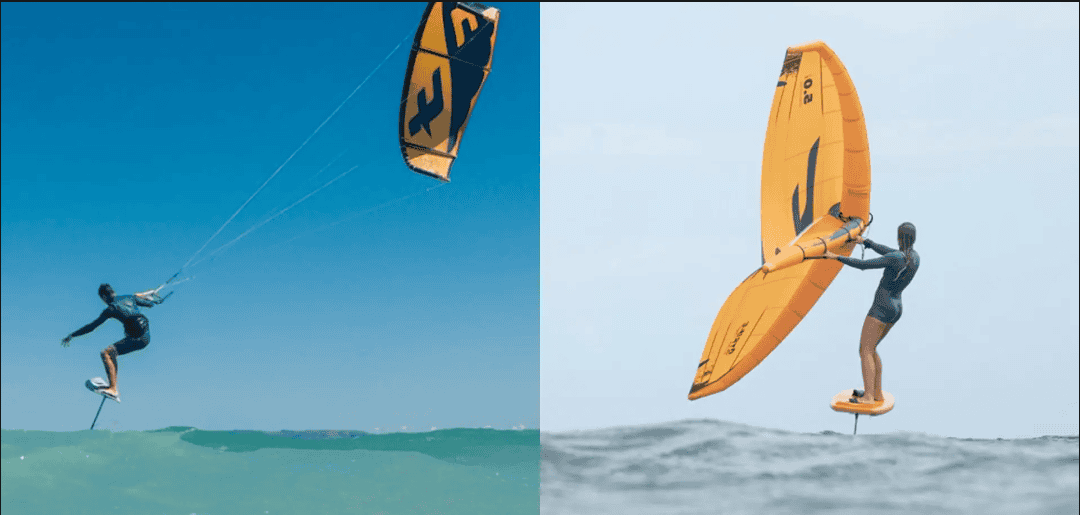
1. The Safety Protocol (Winner: Wing Foiling)
In Kitesurfing, the first 10 hours are dedicated to risk management. You are attached to a high-tension power source. If things go wrong, the consequences are mechanical (lofting, leading-edge tangles).
In Wing Foiling, you aren’t “tethered” to the power in the same way. If you get overpowered, you simply neutralize the wing by letting go of your back hand. In 2026, modern leash systems have made “depowering” a wing instantaneous and 100% mechanical.
Specialist Insight: The “fear factor” in Wing Foiling is significantly lower, which allows beginners to progress through the “clumsy phase” faster.
2. The Technical Breakdown: Wing Foiling vs Kitesurfing 2026
Wait, Kitesurfing is easier? Yes—once you are up.
- With kitesurfing, the hardest part is getting started on the water. Once you are on the board, the kite will provide a steady upward pull that helps your balance.
- Wing Foiling is different. You have two separate battles. First, you must learn to handle the wing. Second, you must master the hydrofoil’s pitch control. In 2026, even with “stable” beginner foils, the balance required to stay on the foil is harder than riding a twin-tip kiteboard.
3. The Gear. Rigging (Winner: Wing Foiling)
If you value your time on the water, Wing Foiling wins the “Specialist Efficiency” award.
- Kitesurfing: 4 lines, bar tuning, pump, harness, and a large “launch zone” requirement.
- Wing Foiling: Inflate the wing, attach the foil (usually 4 bolts in a track), and go. You can launch in 2026 from tiny docks or rocky shorelines where a kite could never fly.
4. Wind Range & Marginal Conditions
In 2026, Lightwind Winging has become the gold standard. Because of the efficiency of modern foils, a specialist can “fly” in 8-10 knots with a 5m wing. While lightwind kites (like the latest single-struts or foils) exist, they require much higher pilot skill to keep in the air during lulls.
Technical Specs: 2026 Comparison
| Feature | Kitesurfing (2026 Tech) | Wing Foiling (2026 Tech) |
| Learning Curve | High initial (Waterstart) | Steeper mid-stage (Foil Flight) |
| Minimum Wind | 12-14 Knots (Twin Tip) | 8-10 Knots (High-Aspect Foil) |
| Safety System | 4-Line Quick Release | Hand-neutralization (Leash) |
| Setup Time | 15 – 20 Minutes | 5 – 8 Minutes |
| Launch Space | Large sandy area required | Small dock or rocky entry |
The Specialist Verdict: What to choose?
- You should choose Kitesurfing if: You want the feeling of “unlimited power”, big jumps and a faster way to feel “stable” once you move past the beginner stage.
- Go for Wing Foiling if: You want a shorter setup time, a lower “danger” profile, and the ability to ride in gusty or marginal wind conditions.
How much learning does it take:
- The Time it takes for the first ride (Kitesurfing): 10-15 hours of instruction.
- Time to first flight (Wing Foiling): 5-10 hours, but 20+ hours to master the “jibe.”
So as you see, it’s all up to you – both Kite and Wing are great!
Interesting for you could also be the way of rules for foilers!




I’ve been riding since 2009 — mostly Red Sea and Mediterranean, a season in Tarifa, a few trips to Brazil. I started this site because the maintenance advice online was either vague or wrong, and I got tired of watching riders show up with gear that should have been retired two seasons ago. I fix what other people ignore.