Hey guys,
You’re watching a kitesurfer on the beach and the kite is flying overhead — calm, controlled, barely pulling at all.
Then the rider steers it forward and suddenly the kite surges with massive power and the board takes off.
Same kite. Same wind. Completely different power level.
How?
That right there is the kitesurfing wind window doing exactly what it’s supposed to do. And once you understand it — really understand it — everything else in kitesurfing starts to make sense. Launching, landing, body dragging, water starts, jumping. All of it is built on this one concept.
This is the wind window kitesurfing explained from the ground up. No jargon, no assumptions. Just the concept that makes everything click.
This post is part of the complete kitesurfing weather guide.
Note: This post contains affiliate links. Full Disclosure.
What Is the Kitesurfing Wind Window?
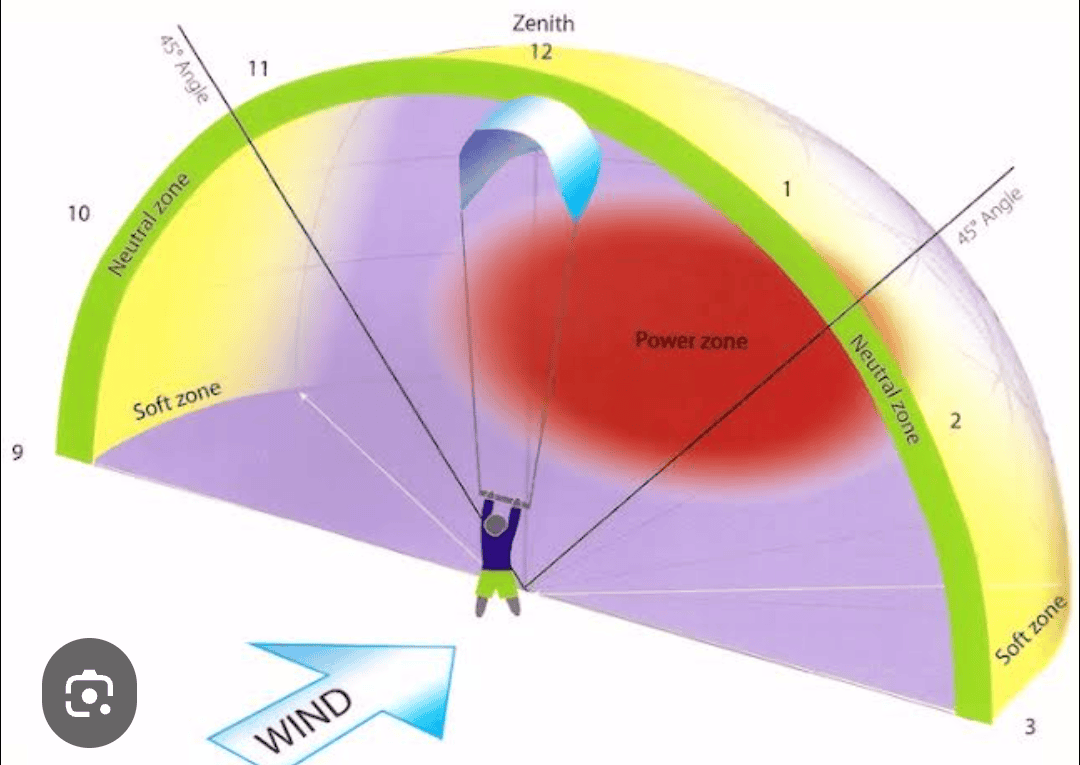
The kitesurfing wind window is the three-dimensional area in front of you where your kite can fly.
Picture yourself standing on the beach facing downwind — facing the direction the wind is blowing toward. Now stretch your arms out wide. Everything in front of you, above you, and to your sides forms a giant quarter-sphere shape. That shape is your wind window.
The kite can only fly within this zone. Move it outside the edges and it stalls and drops. Keep it inside and it flies.
Simple concept. But here’s where it gets interesting — the power your kite generates changes dramatically depending on where inside the window it is.
That’s the part most beginners don’t understand at first. They think wind speed = kite power. But a rider can have a kite in 25 knots producing almost no pull, and the same kite in 15 knots producing massive power — just by where the kite is positioned in the kite flying window.
The Three Zones of the Kite Wind Window
The kite wind window zones are the key to understanding everything that follows. There are three of them and every experienced rider thinks about them constantly — even if they don’t say it out loud.
Zone 1 — The Power Zone
The power zone is the central, forward section of the wind window — directly downwind of you.
When your kite is in the power zone kite riders feel maximum pull. The wind hits the kite face-on, the projected area is at its largest, and the lift and drag forces are at their peak. In strong wind this is the zone that can lift you off your feet, launch you into a jump, or — if you’re not ready — drag you across the beach.
The power zone is roughly the front 60 degrees of the window — anything directly in front of you and slightly to each side. The closer to dead downwind (directly in front of you at low altitude), the more power.
This is where you fly the kite when you want to go — water starts, jumps, riding upwind. You’re using the power zone intentionally.
Zone 2 — The Neutral Zone
Move the kite toward the edge of the window and the power drops significantly. This is the neutral zone — sometimes called the soft zone or the intermediate zone.
In the neutral zone the kite is still flying but the wind is hitting it more from the side than head on. The power zone kite generates is replaced by a much lighter, more manageable pull. The kite is still generating some lift but it’s controllable.
The neutral zone sits roughly between the power zone and the very edge of the window. Think of it as the 10 o’clock and 2 o’clock positions on a clock face — the kite is still overhead but moving toward the sides.
This is where you fly the kite when you’re riding at moderate speed, body dragging, or setting up for a maneuver. Not full power, not parked — actively flying through the window.
Zone 3 — The Edge of the Window
The edge of the window is exactly what it sounds like — the very limit of where the kite can fly.
At the edge, the wind is hitting the kite almost parallel to its surface. The power drops to almost nothing. The kite loses lift and if you push it past the edge it stalls and falls.
The edge of the window is the 9 o’clock and 3 o’clock positions — directly to your sides, perpendicular to the wind.
This is the kite wind window zone you use for launching and landing. Maximum control, minimum power. The kite is almost completely depowered here which is exactly what you want when you’re getting the kite in the air or bringing it back down.
If you read the self-landing guide — this is why we always say bring the kite to the edge of the window first. Now you know the physics behind it.
The Wind Window Explained With a Clock Face
The easiest way to visualize the kite wind window zones is with a clock face. Stand facing downwind and imagine a giant clock in front of you:
12 o’clock — directly overhead. This is the zenith. The kite has moderate power here and is relatively stable. This is your parking position when you’re standing still — the kite just hovers above you with minimal pull. It’s also the most unpredictable position if you let go — the kite can drift in any direction.
1-2 o’clock and 10-11 o’clock — upper edges of the neutral zone. Moderate power, good control. This is where the kite spends a lot of its time during normal riding.
3 o’clock and 9 o’clock — the edge of the window. Minimum power. Launch and landing zone.
Below 3 and 9, moving toward 6 o’clock — the deep power zone. Maximum pull. Water starts and jumping territory. Also where things go wrong fast if you’re not in control.
The wind window for beginners makes much more sense once you have this clock face in your head. Next time you watch a rider on the beach, track where their kite is on that clock face and watch how the power changes. You’ll see it immediately.
How Wind Direction Affects the Window
Here’s something that trips up a lot of beginners — the wind window moves with you.
It’s always centered downwind of wherever you’re standing or riding. Turn 90 degrees and your entire window rotates with you. The power zone is always directly downwind, the edges are always directly to your sides, relative to the wind direction.
This is why reading wind direction before you get on the water matters. You need to know where downwind is before you can understand where your power zone is.
A quick trick for reading wind direction on the beach — use Windy.com before you arrive to get the general direction, then confirm it on the beach by feeling which direction gives you the most wind on your face. That direction is upwind. The opposite is downwind. Your window opens in front of you when you face downwind.
The Wind Window and Launching
Understanding the kitesurfing wind window changes how you think about launching completely.
Why do we always launch from the edge of the window?
Because at the edge the kite has almost no power. You can get it in the air, check that everything is working, and then — and only then — steer it toward the power zone to start riding.
Launching from the power zone would mean the kite goes from zero to full power the moment it lifts off. That’s how people get pulled off their feet and dragged across the beach.
The IKO teaches every beginner to launch from the edge — this is exactly why. The physics of the kite wind window zones makes it the only safe way to do it.
The launch sequence in wind window terms:
- Position the kite at the edge of the window (3 or 9 o’clock)
- Signal your assistant and lift off
- Kite is in the neutral/edge zone — minimal power, full control
- Walk it up to 12 o’clock — parking position
- When ready to ride, steer it toward the power zone
- Feel the power build as it moves into the front of the window
- Go
Every launch you’ll ever do follows this sequence. The wind window for beginners is the foundation that makes this sequence make sense.
The Wind Window and Landing
Same principle in reverse — and this is exactly why the self-landing technique works.
To land safely you need to remove power from the kite before it touches the ground. The way you do that is by steering it to the edge of the window — 3 or 9 o’clock — where the power zone kite generates drops to almost nothing.
Never try to land a kite from the power zone or from 12 o’clock. The kite still has power at those positions and will fight you on the way down.
Edge of the window. Every time.
The Wind Window and Body Dragging
Body dragging is one of the first skills beginners practice — getting pulled through the water by the kite without a board. Understanding the kite flying window makes body dragging much easier to control.
To go downwind — fly the kite through the power zone in a figure-8 pattern. Each sweep through the front of the window generates a surge of power that pulls you forward.
To go upwind — fly the kite higher in the window, toward 11 and 1 o’clock. Less power but better angle.
To stop or slow down — steer the kite to the edge of the window and let the power drop. Simple.
Body dragging is basically the wind window for beginners in its purest form — no board to worry about, just you and the kite exploring what different positions in the window feel like.
The Wind Window and Jumping
Once you’re riding, jumps are all about sending the kite deep into the power zone at the right moment.
As you approach a jump, you steer the kite back toward 12 o’clock — building tension in the lines. Then you send it hard forward into the power zone kite territory. The sudden surge of power combined with your edge loads the lines, and up you go.
The height of a jump is largely determined by how aggressively you send the kite into the power zone and how well you time the edge. Riders who understand the kite wind window zones intuitively can control exactly how much power they generate and therefore how high they go.
Big air riders aren’t just pulling harder — they’re using the full depth of the power zone more aggressively than everyone else.
Common Wind Window Mistakes Beginners Make
Flying the kite too deep in the power zone while standing still If you’re standing on the beach with your kite at 6 o’clock level and forward, you’re going to get pulled off your feet. The kite should be parked at 12 o’clock when you’re not riding — neutral, stable, minimal pull.
Trying to launch from the wrong position Launching from anywhere other than the edge of the window is the most common beginner launch accident. Edge of the window first — always.
Not understanding why the kite suddenly pulls harder It hasn’t — the wind hasn’t changed. The kite has drifted from the neutral zone into the power zone. This is almost always a bar input problem — small, unintended steering inputs moving the kite forward. Bar awareness fixes this.
Trying to steer a stalled kite If the kite drifts past the edge of the window and stalls, you can’t steer it back. You have to let it drop and relaunch from the edge. Trying to save a stalled kite by pulling harder usually makes it worse.
Parking at 12 o’clock in gusty conditions In gusty wind, 12 o’clock is less stable than it seems. A gust can send the kite forward into the power zone unexpectedly. In gusty conditions, park slightly toward the edge — 11 or 1 o’clock — where any forward drift still keeps you in the neutral zone.
Wind Window Kitesurfing Explained — Quick Reference
Here’s the wind window kitesurfing explained in one simple table you can refer back to:
| Position | Zone | Power Level | Use For |
|---|---|---|---|
| 12 o’clock | Zenith | Low-medium | Parking, waiting |
| 10-11 / 1-2 o’clock | Neutral | Medium | Riding, body drag |
| 3 / 9 o’clock | Edge | Minimal | Launch, landing |
| Below centre, forward | Power | Maximum | Water starts, jumps |
Save this. Read it before your first few sessions. It’ll save you a lot of confusion on the beach.
Putting It All Together
The kitesurfing wind window is not a complicated concept — but it’s the foundation that every single thing in kitesurfing is built on.
Once the kite wind window zones are automatic in your head, you stop thinking about them consciously and start using them instinctively. The kite drifts toward the power zone — you feel it and correct. You want to jump — you know exactly where to send the kite. You’re coming in to land — edge of the window, without thinking.
That’s what mastery looks like in this sport. Not tricks. Not big air. Just complete, automatic understanding of where your kite is in the window and what that means.
Everything else — the bar tuning, the self-rescue, the right of way rules, the self-landing — all of it makes more sense once the wind window is locked in.
Get this right first. Everything else follows.
Ride hard. 🤙
Frequently Asked Questions
What is the kitesurfing wind window?
The kitesurfing wind window is the three-dimensional area in front of a rider where the kite can fly. It’s shaped like a quarter-sphere and is always centered downwind of the rider. The kite generates different amounts of power depending on where in the window it is positioned.
What is the power zone in kitesurfing?
The power zone is the front-centre section of the wind window — directly downwind of the rider. This is where the kite generates maximum pull and lift. It’s used for water starts, riding, and jumping. Flying the kite in the power zone when standing still will pull the rider forward — this is why beginners park the kite at 12 o’clock instead.
Where is the edge of the wind window?
The edge of the wind window is directly to the sides of the rider — the 3 o’clock and 9 o’clock positions relative to the wind direction. At the edge the kite has minimal power and is closest to stalling. This is the correct position for launching and landing a kite safely.
Why does kite power change without the wind changing?
Because kite power depends on where in the wind window the kite is positioned, not just wind speed. The same kite in the same wind generates very different amounts of power at 12 o’clock versus in the deep power zone. This is the core concept of the kitesurfing wind window explained simply.
Is the wind window the same for all kite sizes?
The shape and position of the wind window is the same for all kites. A larger kite generates more power throughout the window but the zones stay in the same positions. The power zone is always forward and downwind, the edge is always to the sides, regardless of kite size.
How do I use the wind window for beginners practice?
The best way to practice wind window awareness as a beginner is through kite control exercises on the beach before going on the water — park the kite at 12 o’clock, steer it slowly to the edge, feel the power drop, steer it back to the neutral zone, feel the power return. Do this until the relationship between kite position and power is automatic. Your IKO certified instructor will take you through these exercises in your first lessons.
Got a wind window question that isn’t covered here? Drop it in the comments and I’ll add it to the FAQ.Share




I’ve been riding since 2009 — mostly Red Sea and Mediterranean, a season in Tarifa, a few trips to Brazil. I started this site because the maintenance advice online was either vague or wrong, and I got tired of watching riders show up with gear that should have been retired two seasons ago. I fix what other people ignore.