Hey guys.
I’ve watched a lot of incidents on the water over the years. Close calls, gear failures, riders getting into trouble they couldn’t get out of.
The thing that strikes me every time — it’s almost never bad luck. It’s almost always the same pattern. Rider skips a gear check. Rider goes out in conditions they’re not ready for. Rider doesn’t know what to do when something goes wrong because they’ve never practiced it.
Kitesurfing safety and kiteboarding safety aren’t about being cautious to the point of never riding. It’s about knowing the risks, having the skills, and making decisions that keep you on the water for the next twenty years instead of ending your season — or worse — in the first one.
This kite safety guide covers every skill and system you need — organised so you can find what you need fast.
Note: This post contains affiliate links. Full Disclosure.
Kitesurfing safety covers a lot of ground — kite safety rules on the water, kiteboarding safety around other riders, kitesurfing safety tips for gear and conditions, and knowing how to stay safe kitesurfing when things go wrong. This kite safety guide organises everything in one place.
The Mindset Before the Skills
Kitesurfing safety tips and checklists are useful. But they only work if the mindset is right first.
The riders who stay safe long-term share one characteristic — they’re honest with themselves. About their skill level. About the conditions. About whether their gear is in good enough shape to fly.
The riders who get hurt are usually the ones who knew something wasn’t right and went out anyway. The wind was a bit too strong. The safety release was a bit sticky. The spot was a bit too crowded. And they went out because the session seemed worth the risk.
It rarely is.
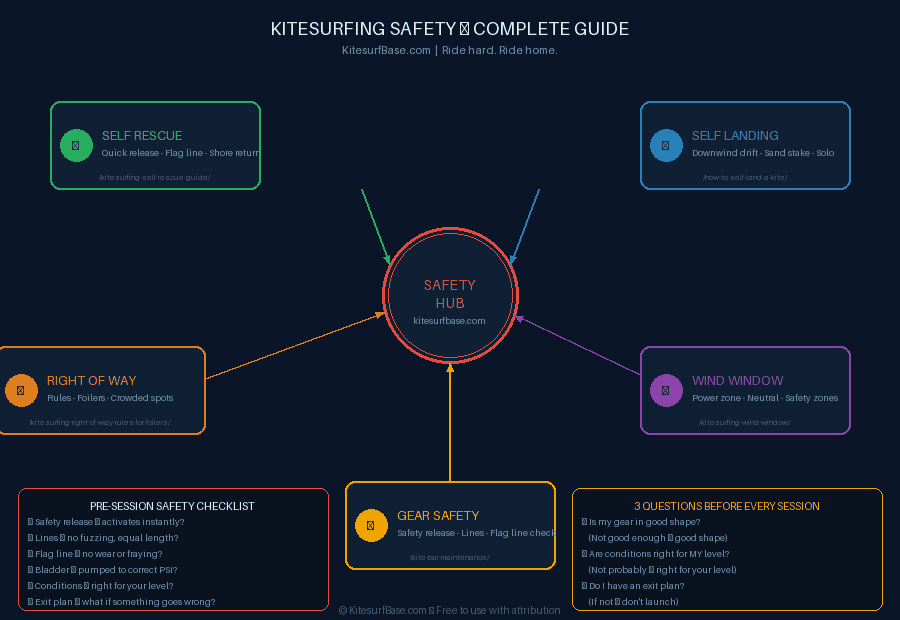
Before every single session — ask yourself three questions:
Is my gear in good shape? Not good enough. Good shape. Safety release working instantly, lines clean and equal, bridle checked, bar rinsed from last session. The kite maintenance calendar has the full pre-session checklist — run through it.
Are the conditions right for my level? Not “can I probably handle it.” Right for your level. There’s no shame in not going out. There’s a lot of shame in having to be rescued by someone else because you misjudged the wind.
Do I have an exit plan? If something goes wrong — line snap, gear failure, sudden wind change — what do you do? If you can’t answer that clearly before you launch, you’re not ready to launch.
Those three questions, honestly answered, prevent most incidents before they start.
Self Rescue — The Most Important Skill You’ll Ever Learn
A self rescue is what you do when everything goes wrong at once. Line snap. Wind drops. Gear failure offshore. You’re in the water, away from shore, and you need to get back.
Most riders know the theory. Very few have actually practiced it. That gap — between knowing and doing — is where incidents happen.
The self rescue technique involves activating your primary quick release, flagging the kite out on a single line, winding your way up to the bar, securing the kite, and using it as a flotation and sailing device to get back to shore. In onshore wind you can sail the kite back. In offshore wind you deflate the leading edge and use it as a float while you swim perpendicular to the wind.
How to stay safe kitesurfing in an emergency comes down to this — stay calm, activate the release without hesitating, and work the system methodically. Panic is what turns a manageable situation into a dangerous one.
The most important thing I can tell you about self rescue: practice it before you need it. Light wind, shallow water, someone watching from shore. Do a dry run. The first time you activate your quick release should not be in an emergency.
→ Full step-by-step guide: Kitesurfing Self Rescue Guide — The 5-Step Protocol
Self Landing — Coming In Without Help
You’ve had a perfect session. You’re coming in. You look up the beach and there’s nobody there to grab your kite.
This happens more than people admit — and it catches riders off guard every time it does. A kite that can’t be landed safely is a kite that becomes a hazard. To you, to other people on the beach, to anyone downwind.
Self landing is a kiteboarding safety skill that every independent rider needs. Not just knowing it exists — actually being able to do it cleanly in moderate conditions without thinking too hard about it.
There are two main methods. The downwind drift — where you steer the kite to the edge of the wind window and walk it down as it loses power. And the sand stake method — where you anchor the bar to a fixed point and depower the kite from a distance. Each has its conditions. Strong wind, light wind, crowded beach, empty beach — the right technique changes.
→ Full step-by-step guide: How to Self Land a Kite Solo — No Helper Needed
Read the full breakdown of the risks of kitesurfing alone before you go solo.
Right of Way — Rules That Prevent Collisions
Crowded spots are where right of way rules matter most. And crowded spots are exactly where most riders stop thinking about them — because there’s too much else going on.
The basic rules are simple and based on World Sailing right of way rules. Rider on starboard tack has right of way.. Rider coming in has right of way over rider going out. Faster rider — a foiler especially — has responsibility to avoid slower riders. But knowing the rules and applying them in the moment, at speed, in a crowded lineup, are two different things.
Kiteboarding safety around foiling deserves special attention. Foilers move faster, fly higher lines, and hit harder than twintip riders. Kite safety rules exist for exactly this reason — the responsibility that comes with that performance advantage is real, and not all foilers take it seriously enough.
→ Full guide: Kitesurfing Right of Way Rules for Foilers
Understanding the Wind Window
Most safety incidents on the water start with a kite in the wrong part of the wind window at the wrong moment. The power zone during a launch. The neutral zone during a crowded crossing. A kite overhead in a gust.
Understanding the wind window isn’t just a beginner concept — it’s the foundation of every safety decision you make on the water. Where the kite is in the window determines how much power it’s generating, how quickly that power can change, and how much control you have over the situation.
Riders who really understand the wind window can place their kite precisely where they need it, depower quickly when the situation demands it, and anticipate what the kite is going to do next. That anticipation is what separates riders who manage close calls from riders who become incidents.
Gear Safety — What Fails and Why
No kite safety guide is complete without talking about gear. A large percentage of kitesurfing safety issues are gear issues in disguise. Equipment that wasn’t checked before the session. A safety release that was sticky last time and ignored. Lines that were worn but not replaced.
The safety release is the single most important safety component on your bar. It should activate instantly with the correct force — every time, without hesitation. Test it before every session. If it feels different from normal — stiffer, stickier, requiring more force — don’t go out until it’s fixed. The kite bar maintenance guide covers exactly how to clean and service it.
Lines fail progressively, not suddenly. A line that snaps during a session has usually been showing wear signs for weeks. Fuzzing, stiffness, discolouration at the knot points — these are the warnings. Check them. Replace them when they need replacing. A full line set costs a fraction of what a safety incident costs.
The flag line — the single line your kite flags onto when you activate your quick release — takes 100% of the load during a self rescue. If that line is worn, the self rescue fails. Check it every month as part of your regular gear maintenance routine.
Beach Safety — Before You Even Launch
These kitesurfing safety tips are the ones most riders skip because they seem obvious. They aren’t.
Reading the conditions honestly. Wind direction matters more than wind speed for safety. Onshore wind — you can get back. Offshore wind — you need a self rescue plan before you go out, not after. Side-offshore is the danger zone that catches riders out because it feels manageable until it isn’t.
Knowing your spot and the kite safety rules that apply there. Obstacles downwind. Shallow areas. Rocky sections. Other water users — swimmers, surfers, other kiters. The two minutes you spend checking the spot before you rig is two minutes that can prevent a serious incident.
Checking your gear on the beach. Not a quick glance — an actual check. Safety release, lines, bridle symmetry, bladder pressure. The pre-session checklist in the maintenance calendar covers every component in order.
Having someone know you’re out. Tell someone where you’re going and when you expect to be back. Not because you’re planning to need rescue — because if you do need it, someone should know to raise the alarm.
→ Full guide: Kitesurfing Beach Safety — Everything Before You Hit the Water
→ Full guide: Kitesurfing Weather — How to Read Wind Forecasts and Pick the Right Day
→ Full guide: Why Your Kitesurfing Harness Is Causing Back Pain (And How to Fix It)
For Beginners — Safety Starts at the School
If you’re just getting started, everything in this guide applies to you — but the most important kitesurfing safety tip for beginners is the one that comes before all of it.
Learn with an IKO certified instructor. Not YouTube. Not a mate who’s been riding for two years. A qualified instructor at a reputable school who follows a structured curriculum and uses proper safety equipment.
The skills you build in your first lessons — how to handle a kite in the power zone, how to use your quick release, how to body drag back to shore — are the exact skills you’ll fall back on in an emergency ten years from now. Build them right from the start.
The kitesurfing for beginners guide covers how to choose a school, what to look for in an instructor, and what the first lessons should cover. Read it before you book anything.
Quick FAQ
What’s the most common cause of kitesurfing incidents?
Rider error in conditions that exceeded their skill level. Not gear failure, not freak accidents — misjudging conditions or going out when they knew something wasn’t right. Of all the kitesurfing safety tips out there — honest self-assessment before every session prevents the majority of incidents.
Do I need a helmet and impact vest?
For beginners — yes, always. For experienced riders — strongly recommended, especially in crowded spots or shallow water. A helmet protects you from your own board, which is the most common source of head injuries in kitesurfing. An impact vest adds flotation and protects your ribs. The cost is minimal compared to what they protect against.
How do I know if conditions are safe for my level?
If you have to ask — they probably aren’t. As a general guide: beginners should be in consistent 12-18 knot wind with onshore or side-onshore direction, uncrowded water, and someone experienced watching. When in doubt, watch from the beach for 20 minutes before rigging. The session will still be there tomorrow.
My safety release is stiff — can I still go out?
No. A stiff safety release is a safety system that might not work when you need it. Clean it, lubricate it, test it. If it’s still not right — don’t fly until it is. The kite bar maintenance guide covers the full service process.
How often should I check my safety gear?
Full gear check monthly as part of your maintenance routine. Quick pre-session check of safety release, lines, and bladder pressure before every single session. It takes five minutes and it’s not optional.
I’ve been riding since 2009. I’ve had close calls. I’ve seen incidents that didn’t need to happen.
The riders I know who’ve been doing this for twenty years without a serious incident aren’t the most cautious riders — they’re the most prepared ones. They check their gear. They know their limits. They have the skills to handle the situations they put themselves in.
That’s how to stay safe kitesurfing long term. Preparation and honesty.
Ride hard — and ride home. 🤙
Something safety-related not covered here? Drop it in the comments.




I’ve been riding since 2009 — mostly Red Sea and Mediterranean, a season in Tarifa, a few trips to Brazil. I started this site because the maintenance advice online was either vague or wrong, and I got tired of watching riders show up with gear that should have been retired two seasons ago. I fix what other people ignore.